
Schorl
Schorl is the most common mineral in the Tourmaline group, and typically occurs as brownish black to dark black acicular prismatic crystals.
These can be very well defined crystals, less defined crystals in matrix, or it can be massive.
Showing all 8 results
-
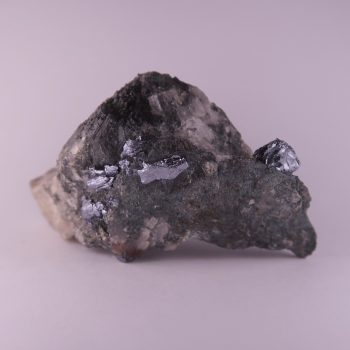
Molybdenite and Schorl from Hingston Down Quarry, Cornwall
Price range: £15.00 through £25.00 -
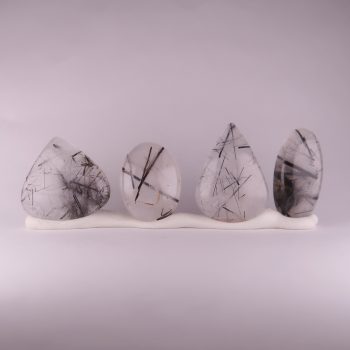

Quartz cabochons (Tourmaline in Quartz)
£5.00 -
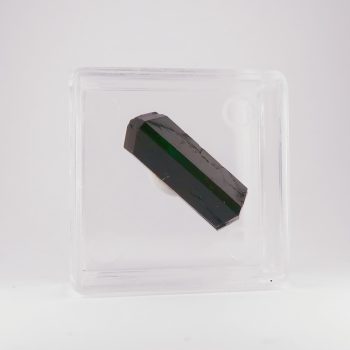
Tourmaline (Schorl) from the Erongo Mountains, Namibia
£5.00 -
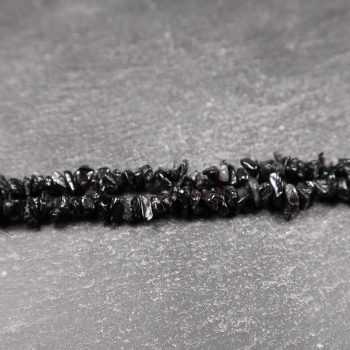
Tourmaline bead strands (Black/Schorl)
£10.00 -
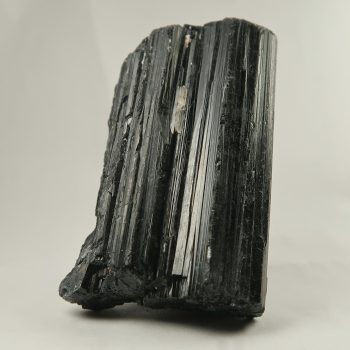
Tourmaline Crystals (Black/Schorl)
Price range: £1.50 through £2.50 -
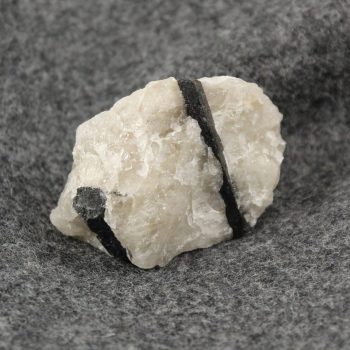
Tourmaline specimens (Black Schorl in Milky Quartz)
Price range: £2.50 through £3.00 -
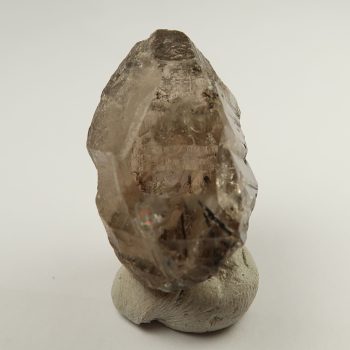
Tourmaline specimens (Black Schorl in Smoky Quartz)
£15.00 -

Tourmaline specimens (Schorl on Feldspar)
£1.50
Information about Schorl
Schorl is the iron-dominant species of the tourmaline group and the most abundant tourmaline by far – it has been estimated to account for 95% or more of all tourmaline in the Earth’s crust, making it one of the most common of all borosilicate minerals despite the fact that tourmaline as a group is typically associated with uncommon geological settings.
Schorl is probably the mineral that most people picture when they hear the word “tourmaline” – jet black, lustrous, striated prismatic crystals in granite, pegmatite, and metamorphic rock – and it is among the most immediately recognisable minerals a collector will encounter.
It forms elongate prismatic crystals with a characteristic triangular cross-section and prominent longitudinal striations parallel to the c-axis. The crystal faces are typically curved in cross-section due to the threefold symmetry of the tourmaline structure, giving a distinctive rounded-triangular appearance in prism section. The terminations are commonly hemimorphic – different at each end – with simple trigonal pyramids rather than the complex polyhedral terminations seen in gem tourmalines. The colour is uniformly black to very dark bluish-black or brownish-black throughout.
Schorl is the sodium iron endmember of the tourmaline group, forming solid solutions with dravite (the magnesium endmember, brown to dark green) and with elbaite (the lithium aluminium endmember, the source of gem-quality coloured tourmalines).
The name has a notably long history. The word Schorl was in use before 1400 AD in the Saxon Ore Mountains, where it originally referred to the black material found in tin mines alongside cassiterite – the tin ore. A village in Saxony then known simply as Schorl, now named Zschorlau, had a nearby tin mine where black tourmaline was abundant, and the mineral name and the village name are likely the same word. The first detailed written description was by Johannes Mathesius in 1562.
Uses and History
Schorl itself has limited gemological value – it is opaque and black – though it is widely used in jewellery under the name black tourmaline, valued both aesthetically and in the contemporary crystal healing tradition.
The electrical properties of tourmaline as a group were of practical interest in the nineteenth century: tourmalines were used by chemists to polarise light, and the Dutch East India Company apparently introduced tourmalines to Europe partly because of their property of attracting and repelling ash when heated – giving them the name Ceylonese Magnets.
Modern industrial applications of tourmaline include pressure gauges and vibration sensors exploiting the piezoelectric effect.
The finest black schorl specimens valued by collectors tend to come from localities where large, sharp, well-terminated crystals grow in high-contrast pale matrices. Exceptional specimens come from Namibia (particularly from the Erongo Complex), where schorl crystals up to tens of centimetres in length grow in milky quartz and feldspar; from Pakistan (Shigar Valley, Gilgit-Baltistan); from Brazil; and from many localities in the USA. European localities include numerous sites in Cornwall, England, where schorl is so abundant in the tourmalinised granite known as schorl rock that the term “schorl” was used in Cornish mining as a general term for waste.
Mineralogy
3 Al6(BO3)3Si6O18(OH)4. Trigonal. The iron-dominant endmember of the tourmaline group; forms solid solutions with dravite (Mg-dominant) and elbaite (Li,Al-dominant).
Hazards and Warnings
No specific health risks are associated with schorl under normal handling conditions.
Almost all rocks, minerals (and, frankly, almost all other substances on earth) can produce toxic dust when cutting, which can cause serious respiratory conditions including silicosis. When cutting or polishing rocks, minerals, shells, etc, all work should be done wet to minimise the dust, and a suitable respirator or extraction system should be used.
Translations
Arabic:
Hindi:
- शॉर्ल
Portuguese:
- Shorl / Turmalina negra
Bengali:
Indonesian:
Punjabi:
English:
- Schorl
- Black Tourmaline
Italian:
- Schorl / Tormalina nera
Russian:
- Шерл
French:
- Schorl / Tourmaline noire
Japanese:
- 鉄電気石
Spanish:
- Schorl / Turmalina negra
German:
- Schörl
Korean:
Thai:
Gujurati:
Mandarin Chinese:
- 铁电气石
Urdu: