
Yofortierite
Yofortierite is a tan brown to yellow to orange fibrous mineral found in some manganese deposits. It forms soft, hair-like bundles.
Showing the single result
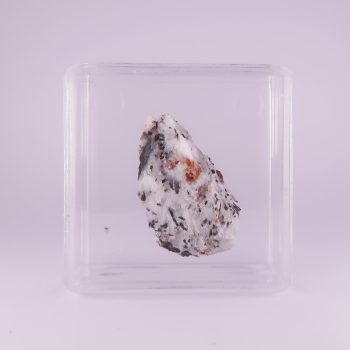
Information about Yofortierite
Yofortierite is an exceptionally rare manganese silicate mineral known from only a tiny number of localities worldwide, and almost exclusively associated with one of mineralogy’s most celebrated sites. It is a scientific curiosity rather than a showy collector’s piece, forming small, pale, fibrous to platy rosettes that require magnification to fully appreciate, but that carry considerable scientific interest given the unusual chemistry of the rocks in which they form.
It typically occurs as tiny radiating sprays or platy rosettes of fibrous crystals, typically pale pink to pinkish-brown, colourless, or pale grey in colour, with a silky to dull lustre. Individual rosettes are usually only a few millimetres across at most.
Specimens from the Lovozero Massif in Russia are noted to form brownish altered platy rosettes of broadly similar habit. In both settings the mineral occurs embedded within or on the surfaces of dark, fine-grained alkaline rock, where the contrast between the pale crystal sprays and their dark matrix provides the best visual distinction.
Yofortierite is a member of the palygorskite group – a group of fibrous hydrated silicate minerals – and is the manganese-dominant member of that group, where manganese takes the structural role more commonly played by magnesium or aluminium in related minerals. It forms as a late-stage mineral in pegmatite veins within unusual alkaline igneous rocks, the same highly specialised geological environment responsible for producing so many of the extraordinary rare minerals for which Mont Saint-Hilaire is famous. When first collected it was mistaken for a chlorite, and its true identity as a new species was only established on detailed chemical and structural analysis.
Uses and History
Yofortierite has no industrial or gemological applications whatsoever. It is collected purely as a scientific rarity, almost always by specialists with a particular interest in either manganese silicates or the mineralogy of alkaline igneous complexes.
The mineral was first described in 1975 by Guy Perrault, Yves Harvey, and Raymond Pertsowsky, from specimens collected at the Poudrette quarry at Mont Saint-Hilaire in Quebec, Canada – its type locality. The original description was published in French in The Canadian Mineralogist under the title “La yofortierite, un nouveau silicate hydraté de manganèse de St-Hilaire, P.Q.”
The mineral was named in honour of Yves Oscar Fortier (1914-1994), who served as director of the Geological Survey of Canada from 1964 to 1972 and who had made important contributions to Canadian geology, particularly in the Arctic. Its crystal structure was not fully resolved until 2013, when Hawthorne, Abdu, Tait, and Back published a detailed structural study in The Canadian Mineralogist – nearly four decades after its original description.
The Poudrette quarry at Mont Saint-Hilaire in Quebec remains overwhelmingly the primary source and the site from which almost all collectable specimens originate. A second confirmed occurrence exists at the Lovozero Massif on the Kola Peninsula in Russia – another of the world’s great alkaline igneous complexes, and a site that shares several unusual mineral species with Mont Saint-Hilaire due to the geological similarities between the two. A further occurrence has been recorded at the Demix-Varennes quarry at Saint-Amable, also in Quebec, Canada.
Mineralogy
Hazards and Warnings
No specific health risks have been formally recorded for yofortierite. As a member of the palygorskite group, which includes some fibrous minerals, collectors should take care to avoid inhaling any dust from specimens and should wash their hands after handling as a matter of good practice.
Almost all rocks, minerals (and, frankly, almost all other substances on earth) can produce toxic dust when cutting, which can cause serious respiratory conditions including silicosis. When cutting or polishing rocks, minerals, shells, etc, all work should be done wet to minimise the dust, and a suitable respirator or extraction system should be used.
Translations
Arabic:
Hindi:
Portuguese:
- Yofortierita
Bengali:
Indonesian:
Punjabi:
English:
- Yofortierite
Italian:
- Yofortierite
Russian:
- Йофортьерит
French:
- Yofortierite
Japanese:
Spanish:
- Yofortierita
German:
- Yofortierit
Korean:
Thai:
Gujurati:
Mandarin Chinese:
Urdu: