
Millerite
Millerite is a nickel sulphide mineral, sometimes known as nickel blende.
It often forms interesting radiating clusters of acicular crystals, sometimes with an iridescent tarnish.
Showing all 2 results
- Updated
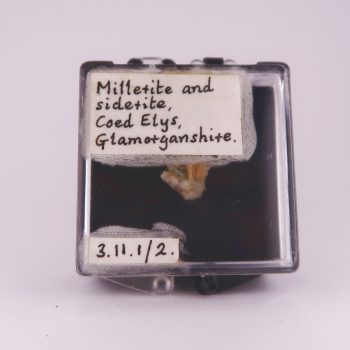
Millerite from Coed-Ely Colliery, Wales
Price range: £5.00 through £20.00 -
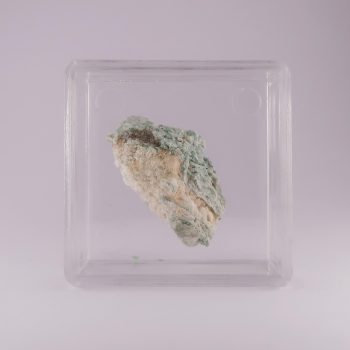

Millerite from La Buscalie, France
£10.00
Information about Millerite
Millerite is a nickel sulphide mineral best known among collectors for its extraordinary hair-like to needle-like crystals, which form gossamer radiating tufts and furry masses of pale brassy gold that are quite unlike any other common mineral in appearance. It is one of those minerals whose appeal is entirely in its habit rather than in spectacular colour or size – a fine millerite specimen, with its delicate golden fibres catching the light, is a genuinely impressive thing.
It occurs most commonly as slender acicular to capillary (hair-like) crystals, often arranged in radiating or tangled masses lining cavities in carbonate rocks such as limestone and dolomite. At the finest localities, individual crystals can reach 5-8 cm in length whilst remaining hair-thin. It is typically pale brassy yellow to golden yellow, occasionally greenish-grey as it weathers and alters to secondary nickel minerals such as violarite. It has a bright metallic lustre and no cleavage.
Millerite forms in two quite different geological settings. The more familiar to collectors is in low-temperature hydrothermal veins and in cavities within carbonate sedimentary rocks – limestones and dolostones – where it crystallises from nickel-bearing fluids at relatively modest temperatures. In this setting, millerite is the mineral responsible for the spectacular gossamer-crystal specimens for which it is best known. The second setting is metamorphic: millerite forms as a replacement product when nickel-bearing minerals such as pentlandite are subjected to metamorphism, particularly during serpentinisation of ultramafic rocks. Material from this second setting is rarely collectable but is of great economic importance, as millerite concentrates more nickel per unit mass than pentlandite – making it a valuable ore mineral wherever it occurs in sufficient quantity.
Millerite has additionally been found in nickel-iron meteorites, including carbonaceous chondrites, and as a sublimation product at the fumaroles of Mount Vesuvius.
Uses and History
Millerite is a minor ore of nickel, though it is rarely mined directly and more commonly treated as a by-product of broader nickel and copper sulphide mining operations. It has no gemological applications, though occasionally cabochons are cut from massive material – I absolutely do not recommend this, as nickel is a common allergen.
The mineral has a particularly strong Welsh identity. The first illustrated record of the mineral appears in Volume 3 of James Sowerby’s celebrated series British Mineralogy, published in 1808, where a plate dated that year depicts “hair pyrites” from a South Wales coalfield ironstone – predating the formal description of the mineral by nearly four decades. The first scientific description was published in 1842 by W.H. Miller, Professor of Mineralogy at the University of Cambridge, who described crystals of “sulphide of nickel” from the Coal Measures of South Wales. Miller was one of the founders of modern crystallography, best known for devising the system of crystallographic notation – the Miller indices – still universally used to describe crystal faces today. In recognition of his contributions, the Austrian mineralogist Wilhelm Haidinger formally named the mineral millerite in his honour in 1845.
The South Wales coalfield is one of the most celebrated millerite localities in the world. Millerite occurs throughout the coalfield in septarian ironstone nodules, where it forms on cavities lined with siderite alongside a varied suite of associated sulphides. Today, millerite from the coalfield is primarily found during coal-tip reclamation and opencast mining operations, which briefly expose the ironstone nodules.
Notable recent discoveries have come from Coed Ely Colliery near Llantrisant, International Colliery at Blaengarw, the Gelli and Ferndale collieries in the Rhondda, Deep Navigation Colliery at Treharris, Wyndham Colliery at Ogmore Vale, Park Slip West near Bridgend, and Nant Helen near Ystradgynlais. In the Central Wales Orefield, millerite has also been confirmed from hydrothermal ore deposits in the Talybont district of Ceredigion, with the finest Central Wales material coming from Brynyrafr Mine at Ponterwyd, where tangled masses of twisted golden needles up to 20 mm span quartz cavities.
Outside Wales and the United Kingdom, notable localities include the Halls Gap area of Lincoln County, Kentucky, USA, which is currently the most prolific source of fine collector specimens, yielding long golden needles in geodes; Antwerp and Gouverneur in New York State, USA, where the Sterling Mine has produced exceptional specimens; Keokuk in Iowa and localities in Missouri and Wisconsin, USA; the Thompson Mine in Manitoba, Canada, a major nickel sulphide operation producing massive millerite of economic importance; Marbridge Mine in Quebec, Canada; Kladno in the Czech Republic; the Saar coalfield on the French-German border; and the Böckstein Mine at Bad Gastein in Austria.
Mineralogy
Hazards and Warnings
Toxic mineral: contains nickel and sulphur. Nickel is a known skin sensitiser and allergen in some individuals; prolonged skin contact with specimens should be avoided. Mineral collectors should wash their hands after handling specimens as a matter of good practice.
Almost all rocks, minerals (and, frankly, almost all other substances on earth) can produce toxic dust when cutting, which can cause serious respiratory conditions including silicosis. When cutting or polishing rocks, minerals, shells, etc, all work should be done wet to minimise the dust, and a suitable respirator or extraction system should be used.
Translations
Arabic:
Hindi:
Portuguese:
- Millerita
Bengali:
Indonesian:
Punjabi:
English:
- Millerite
- Hair Pyrites (historical)
- Capillary Pyrites (historical)
- Nickel Blende (historical)
Italian:
- Millerite
Russian:
- Миллерит
French:
- Millérite
Japanese:
- 針ニッケル鉱
Spanish:
- Millerita
German:
- Millerit
- Haarkies (historical)
Korean:
Thai:
Gujurati:
Mandarin Chinese:
- 针镍矿
Urdu: