
Dyscrasite
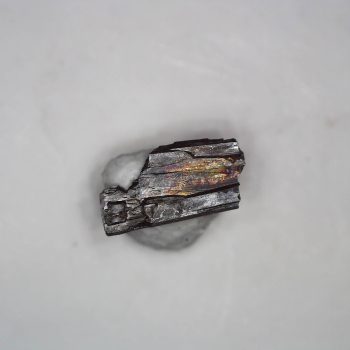
A silver antimonide mineral which occurs in some silver deposits, which can sometimes form interesting crystalline specimens.
Toxic mineral: contains antimony.
Showing the single result
Information about Dyscrasite
Dyscrasite is a rare silver antimonide mineral, a natural alloy of silver and antimony, forming in low-temperature hydrothermal silver ore veins. It is prized by collectors for its silvery-white to tin-white colour, metallic lustre, and occasionally well-formed orthorhombic crystals – sometimes wedge-shaped or tabular – as well as dendritic or massive forms.
Fresh surfaces are bright and metallic, though specimens may tarnish to yellowish or iridescent hues on exposure to air. As a native silver mineral with high silver content it belongs to the exclusive company of silver-bearing species sought by collectors of native metals and silver ore minerals.
The most celebrated specimens come from the silver mining districts of St Andreasberg in the Harz Mountains of Germany, which has produced fine crystallised examples, and from Wolfach in the Black Forest. Exceptional material has also come from Broken Hill in New South Wales, Australia, and from various silver mining localities in Mexico and the Cobalt district of Ontario, Canada.
The name derives from the Greek dyskrasia, meaning bad mixture or bad alloy, reflecting the archaic view that antimony was an adulterant degrading the purity of silver — an ironic etymology given that the mineral is now valued precisely for its combination of the two elements.
Uses and History
Dyscrasite was first described using material from the Wenzel Mine, Germany.
The Harz Mountains and Black Forest silver deposits in which it was first characterised were among the most important silver-producing regions in medieval and early modern Europe, supplying silver to the Holy Roman Empire and beyond.
Although dyscrasite contains substantial silver – typically around 70–75% silver by weight – it is not and has not been an economically significant silver ore mineral in its own right, occurring only in small quantities. It is collected primarily as a specimen mineral and as a representative of the native metal and natural alloy class. The antimonial silver minerals as a group, including dyscrasite, allargentum, and various sulphosalts, are of interest to mineralogists studying the geochemistry of silver enrichment in hydrothermal systems.
Mineralogy
Hazards and Warnings
Contains antimony. Antimony compounds are toxic; the metallic form presents lower risk but dust should not be inhaled. Wash hands after handling.
Almost all rocks, minerals (and, frankly, almost all other substances on earth) can produce toxic dust when cutting, which can cause serious respiratory conditions including silicosis. When cutting or polishing rocks, minerals, shells, etc, all work should be done wet to minimise the dust, and a suitable respirator or extraction system should be used.
Translations
Arabic:
Hindi:
Portuguese:
- Discrasita
Bengali:
Indonesian:
Punjabi:
English:
- Dyscrasite
Italian:
- Discrasite
Russian:
- Дискразит
French:
- Discrasite
Japanese:
- ジスクラサイト
Spanish:
- Discrasita
German:
- Diskrasit
Korean:
Thai:
Gujurati:
Mandarin Chinese:
Urdu: