
Duftite
Duftite is a copper-lead arsenate mineral which forms as a secondary mineral in the weathered zones of sulphide ore deposits.
It is typically an olive-green colour and is mostly of interest to micromineral collectors.
Toxic mineral: contains lead, arsenic.
Showing the single result
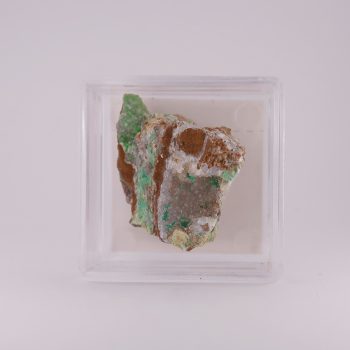
Information about Duftite
Duftite is a secondary lead copper arsenate hydroxide mineral forming in the oxidised zones of lead-copper-arsenic ore deposits, highly regarded by collectors for its vivid apple-green to olive-green colour and its typically well-formed small orthorhombic crystals, often as drusy coatings or radiated aggregates on matrix.
It belongs to the adelite-descloizite group and is the lead-copper arsenate analogue of adelite (calcium copper arsenate). The colour is one of duftite’s most attractive features — a clean, warm green that sets it apart from many other secondary lead and copper minerals.
The finest and most celebrated specimens come from Tsumeb in Namibia, which has produced superb examples of bright apple-green duftite crystals of exceptional clarity and lustre, often on gossan or smithsonite matrix, and which remains the definitive source for collector-quality material. Additional localities include the Clara mine at Oberwolfach in the Black Forest, Germany, and various oxidised lead-zinc-copper deposits in Namibia and Morocco.
The mineral is named in honour of Gustav Duft, a director of the Tsumeb mine in Namibia in the early twentieth century, recognising his role in facilitating mineralogical study of the exceptional Tsumeb deposit. It was first described in 1920 by Georg Berg.
Uses and History
Duftite was first described by Georg Berg in 1920, based on material from Tsumeb, which was, and remains, its most celebrated locality. The Tsumeb deposit in northern Namibia is one of the most mineralogically diverse ore deposits known, having yielded over 240 mineral species including numerous type minerals. Its exceptional diversity arises from an unusually complex primary ore assemblage of copper, lead, zinc, arsenic, antimony, and germanium minerals, which on oxidation generated an extraordinary range of secondary species.
Duftite has no commercial applications and is valued purely as a specimen mineral. It is a useful indicator mineral in oxidised lead-copper-arsenic zones and is sometimes associated with mimetite, olivenite, and other secondary arsenates.
The only UK locale I am aware of is the well known Penberthy Croft Mine.
Mineralogy
Hazards and Warnings
Toxic mineral: contains lead and arsenic. Both lead and arsenic are serious toxins. Wash hands thoroughly after handling, avoid inhaling dust, and keep away from children and food preparation areas.
Almost all rocks, minerals (and, frankly, almost all other substances on earth) can produce toxic dust when cutting, which can cause serious respiratory conditions including silicosis. When cutting or polishing rocks, minerals, shells, etc, all work should be done wet to minimise the dust, and a suitable respirator or extraction system should be used.
Translations
Arabic:
Hindi:
Portuguese:
- Duftita
Bengali:
Indonesian:
Punjabi:
English:
- Duftite
Italian:
- Duftite
Russian:
- Дюфтит
French:
- Duftite
Japanese:
- デュフタイト
Spanish:
- Duftita
German:
- Duftit
Korean:
Thai:
Gujurati:
Mandarin Chinese:
- 杜夫特石
Urdu: