
Brookite
Brookite is a form of titanium dioxide, which forms excellent micro crystals, often alongside quartz – and sometimes with other titanium minerals – anatase, rutile.
It is probably primarily of interest to micromineral collectors.
Showing all 2 results
-
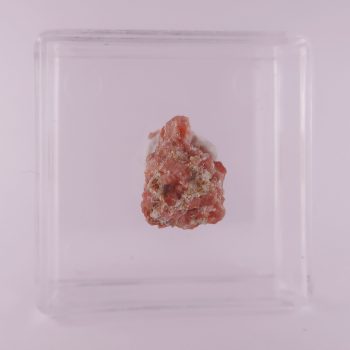
Anatase and Brookite from Shap Pink Quarry, Cumbria
£3.50 -
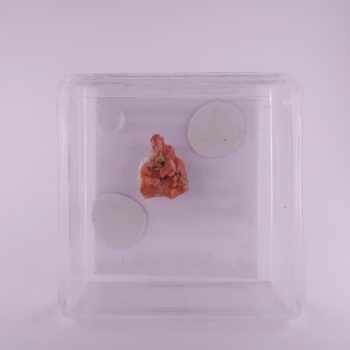

Brookite from Shap Pink Quarry, Cumbria
£3.00
Information about Brookite
Brookite is one of four polymorphs of titanium dioxide – the others being rutile (tetragonal), Akaogiite (monoclinic), and anatase (tetragonal) – and is the orthorhombic member of the group, the second rarest of the four, and the one that forms at relatively moderate temperatures in metamorphic and hydrothermal environments.
It is also, at the finest examples, one of the most visually spectacular of all oxide minerals: the tabular to pyramidal crystals from Magnet Cove in Arkansas and from the Binntal in Switzerland are dark reddish-brown to black with an adamantine to sub-metallic lustre that gives them an extraordinary internal depth and brilliance, and it is no exaggeration to say that a large sharp brookite crystal rivals fine cassiterite or sphalerite in visual impact.
It typically forms tabular crystals – flat, square to rhombic plates – or pseudopyramidal forms, sometimes striated, with a distinctive dark reddish-brown to nearly black colour and a bright adamantine to resinous lustre.
The crystals from Tremadoc in North Wales, which are among the type locality material and are widely held in British museum collections, are dark brown to reddish-brown with excellent lustre. Brookite is famously Wales’s emblematic mineral: it was first described from a Welsh locality, is illustrated in the Museum of Wales guide to Welsh minerals as one of the species for which Wales is most celebrated, and specimens with confirmed Welsh provenance are historically among the most collected and documented of all British minerals.
All of the TiO2 polymorphs transform to rutile at high temperatures, the stable high-temperature form. Brookite is stable over a somewhat wider pressure-temperature range than anatase but at elevated temperatures both invert irreversibly to rutile.
Uses and History
Brookite is of no commercial significance as a titanium ore – it occurs only in modest quantities at any locality – but titanium dioxide generally is one of the most important industrial minerals in the world, used as a white pigment in paint, plastics, paper, and food colouring (E171).
The mineral was first described in 1825 by the French mineralogist Armand Lévy, from specimens collected in Gwynedd, North Wales, its type locality.
It was named in honour of Henry James Brooke (1771-1857), a British crystallographer, mineralogist, and wool merchant who contributed to British mineralogy through his careful crystallographic measurements and several crystallographic reference books.
The finest collector specimens come from Magnet Cove in Hot Spring County, Arkansas, USA, which has produced dark reddish-brown pseudopyramidal crystals considered the finest of species for form and lustre; the Kharan District of Pakistan, the Binntal (Binn Valley) in Valais, Switzerland, where brookite occurs in Alpine fissure veins alongside other titanium minerals; the Snowdon / Yr Wyddfa area and surrounding Gwynedd metamorphic rocks in Wales; and the Miask (Miass) area in the Urals, Russia.
In Wales specifically, brookite is recorded from Tremadog (the type locality) and from the Snowdonia region broadly, where it occurs in metamorphic veins and is one of the minerals for which Wales is internationally known.
Fine micros of brookite can be found in a great many localities worldwide, too.
Mineralogy
Hazards and Warnings
No specific health risks are associated with brookite under normal handling conditions.
Almost all rocks, minerals (and, frankly, almost all other substances on earth) can produce toxic dust when cutting, which can cause serious respiratory conditions including silicosis. When cutting or polishing rocks, minerals, shells, etc, all work should be done wet to minimise the dust, and a suitable respirator or extraction system should be used.
Translations
Arabic:
Hindi:
Portuguese:
- Brookita
Bengali:
Indonesian:
Punjabi:
English:
- Brookite
Italian:
- Brookite
Russian:
- Брукит
French:
- Brookite
Japanese:
- 板チタン石
Spanish:
- Brookita
German:
- Brookit
Korean:
- 브루카이트
Thai:
Gujurati:
Mandarin Chinese:
- 板钛矿
Urdu: