
Brochantite
A secondary copper sulphate mineral which occurs in the oxidised zones of copper bearing orebodies.
Can form some exceptional micro mineral specimens.
Showing all 9 results
-
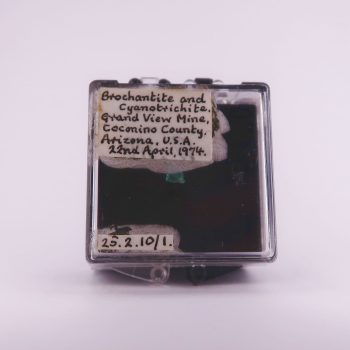
Brochantite and Cyanotrichite from Grand View Mine, USA
£10.00 -
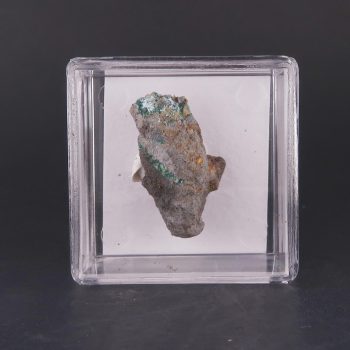

Brochantite and Serpierite from Ystrad Einion Mine, Wales
£5.00 -
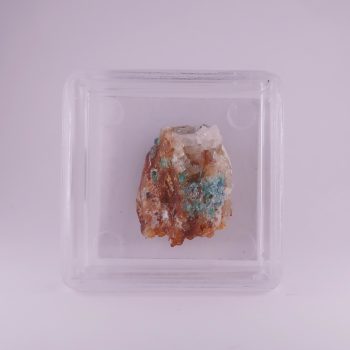
Brochantite from Brae Fell Mine, Cumbria
£5.00 -
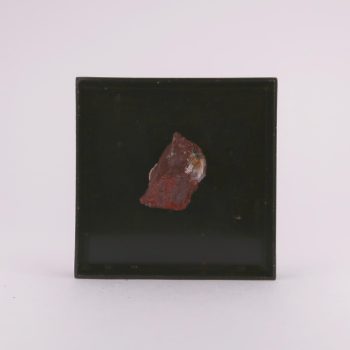
Brochantite from Geevor Mine, Cornwall
£10.00 -
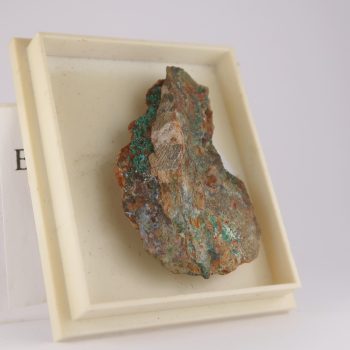
Brochantite from Hafan Mine, Wales
Price range: £7.50 through £10.00 -
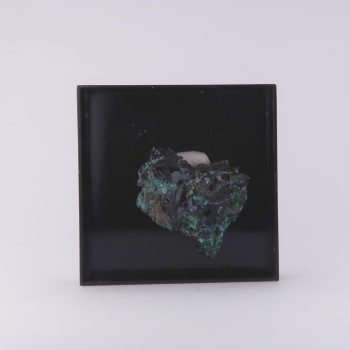
Brochantite from Haltcliffe Copper Smelter, Cumbria
£7.50 -
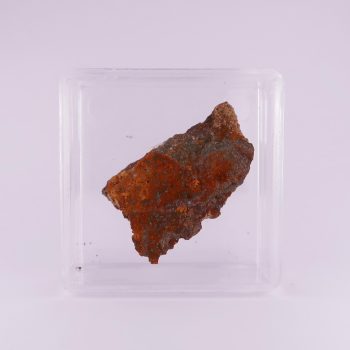
Brochantite from Penberthy Croft Mine, Cornwall
£3.50 -
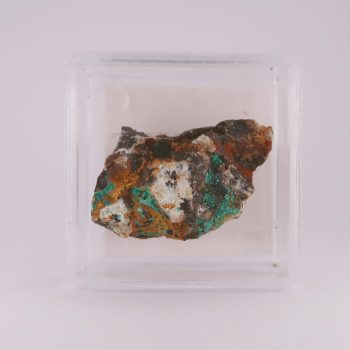
Brochantite from Roughton Gill Mine, Cumbria
£5.00 -
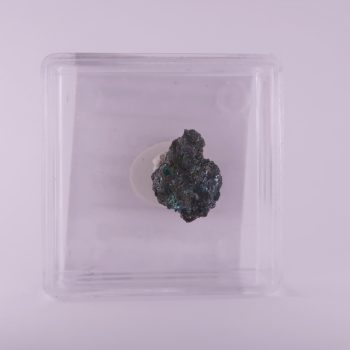
Devilline and Brochantite from Haltcliffe Copper Smelter, Cumbria
£2.50
Information about Brochantite
Brochantite is one of the most widely distributed secondary copper minerals, forming brilliant emerald-green to dark green prismatic crystals and acicular aggregates in the oxidised zones of copper ore deposits worldwide – and also, less obviously, as a common corrosion product on the surfaces of outdoor bronze statues, copper roofing, and other architectural copper exposed to urban atmospheres. It forms a large part of the green patina on the Statue of Liberty.
For collectors the finest crystallised specimens from localities such as Milpillas in Mexico and the Laurion district of Greece are genuinely beautiful; for mineralogists brochantite is notable as one of the most stable secondary copper sulphate minerals and the one most commonly responsible for the green colour of copper-bearing oxidised zones in humid environments.
It forms short prismatic to acicular crystals, often striated lengthwise, in brilliant emerald-green with a vitreous lustre, either as isolated crystals or in radiating groups, druses, and dense fibrous crusts.
It may form pseudomorphs after malachite, azurite, and langite, and can itself be replaced by chrysocolla. Acicular brochantite has occasionally been confused with acicular dioptase in old collections.
Brochantite forms in the oxidised zones of copper sulphide deposits where sulphate-bearing oxidising groundwater contacts copper-bearing minerals. Its relative stability compared to malachite and azurite means it tends to persist further from the primary sulphide zone and is often the last secondary copper mineral to form before complete oxidation to chrysocolla and iron hydroxides.
Uses and History
Brochantite has no industrial applications. It is one of the most commonly collected secondary copper minerals, with well-crystallised specimens from fine localities being highly sought.
It was first described in 1824 by the French mineralogist Serve-Dieu Abailard “Armand” Lévy, who named it in honour of André Jean François Marie Brochant de Villiers (1772-1840), Professor at the École des Mines in Paris, distinguished French geologist and cartographer, and the director of France’s first geological map.
The finest collector specimens come from the Milpillas Mine near Cananea in Sonora, Mexico, which has produced large, brilliantly lustred crystals considered among the finest of species; Bisbee in Cochise County, Arizona, USA; the Laurion (Lavrion) district in Attica, Greece, particularly the Jean Baptiste and Kamariza mines; and the Cerro Colorado Mine in the Tarapacá Region of Chile.
Mineralogy
Hazards and Warnings
Toxic mineral: contains copper. Copper compounds are toxic. Mineral collectors should wash their hands after handling specimens and avoid any contact with the mouth or inhalation of dust.
Almost all rocks, minerals (and, frankly, almost all other substances on earth) can produce toxic dust when cutting, which can cause serious respiratory conditions including silicosis. When cutting or polishing rocks, minerals, shells, etc, all work should be done wet to minimise the dust, and a suitable respirator or extraction system should be used.
Translations
Arabic:
Hindi:
Portuguese:
- Brochantita
Bengali:
Indonesian:
Punjabi:
English:
- Brochantite
Italian:
- Brochantite
Russian:
- Брошантит
French:
- Brochantite
Japanese:
- ブロシャン石
Spanish:
- Brochantita
German:
- Brochantit
Korean:
Thai:
Gujurati:
Mandarin Chinese:
Urdu: