
Boleite
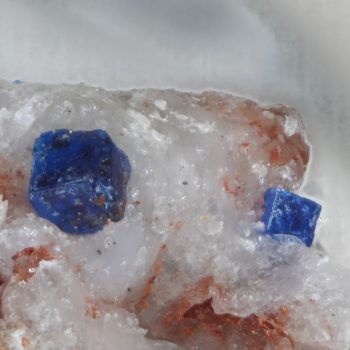
Boleite is a halide mineral which forms rich, deep blue cubes. Rather rare, and the striking specimens it forms are likely to be of interest to micro mineral collectors.
Toxic mineral: contains lead.
Showing the single result
Information about Boleite
Boleite is one of the most visually distinctive minerals in any collection – an intensely deep indigo-blue to Prussian blue mineral that forms as sharp, perfect cubes of startling colour. It is among the rarer and more sought-after secondary minerals known, and a well-crystallised specimen is a genuinely desirable acquisition.
It typically forms as small cubic crystals, usually only a few millimetres across, though exceptional examples from its type locality can reach 2 cm – pieces of that size being extremely sought-after and correspondingly valuable.
The crystals are often found overgrown by, or intergrown with, pseudoboleite and cumengite – closely related minerals that share a similar intense blue colour and structure – creating complex, layered crystal aggregates of considerable beauty. It has a metallic to submetallic lustre, a blue-green streak, and is translucent in thin crystals.
Boleite forms exclusively under very specific conditions – in the oxidised, near-surface zones of lead and copper ore deposits in hot, arid climates where saline groundwater or seawater provides the chloride necessary for its formation. It has also been found, less commonly, in smelter slag that has been immersed in seawater for extended periods, where the same chemistry is replicated artificially. Outside of these conditions it simply does not form, which explains both its rarity and the very limited number of localities at which it is known.
Its formula is one of the most complex of any mineral – KPb26Ag9Cu24Cl62(OH)48 – incorporating potassium, lead, silver, copper, chlorine, and hydroxide all within a single structure. It is closely related to pseudoboleite, cumengite, and diaboleite, all of which share a similar structural framework and the same extraordinary blue colour, and which frequently occur together on the same specimen.
Uses and History
Boleite has no industrial or gemological applications in the conventional sense, though its colour and rarity mean that it is occasionally faceted into collector gemstones – transparent, faceted boleite is exceptionally rare and commands considerable prices.
The mineral was first described in 1891 by the French crystallographer François Ernest Mallard and the Boleo mine engineer Bernard Louis Philippe Édouard Cumenge, from specimens collected at the Amelia Mine in the Boleo district near Santa Rosalía in Baja California, Mexico – its type locality, and still by far the most celebrated source of fine specimens. The mineral was named after that locality. Cumenge’s name was in turn given to the closely related cumengite, described from the same site in the same publication.
The Amelia Mine specimens collected during the active mining period in the late 19th century remain among the finest ever found, and old-collection boleite from that period – sometimes still in their original dealer boxes – are highly prized by collectors. Active mining at Boleo has long since ceased, and new specimens from the type locality are now rare.
Outside Mexico, verified localities include the San Francisco Mine at Caracoles in the Atacama Desert of Chile; the Broken Hill district in New South Wales, Australia; the Kolwezi district of the Democratic Republic of the Congo; and Iran. In England, boleite and pseudoboleite have been recorded from the Gannel Smelter slag locality at Crantock in Cornwall – a historically significant occurrence where copper and lead smelting slag, immersed in the Gannel estuary for centuries, has produced a small but remarkable range of secondary chloride minerals through the action of seawater. In France, microcrystals have been recorded from foundry residues at the Huelgoat lead mine in Finistère, Brittany.
Mineralogy
Given its extreme rarity and the very limited number of known localities, provenance documentation is the single most important factor in confirming a genuine specimen. Definitive distinction from pseudoboleite and cumengite requires X-ray diffraction.
Hazards and Warnings
Toxic mineral: contains lead, silver, and copper. Mineral collectors should wash their hands thoroughly after handling specimens, to avoid any exposure to potential toxins. Specimens should be stored safely away from children and food preparation areas.
Almost all rocks, minerals (and, frankly, almost all other substances on earth) can produce toxic dust when cutting, which can cause serious respiratory conditions including silicosis. When cutting or polishing rocks, minerals, shells, etc, all work should be done wet to minimise the dust, and a suitable respirator or extraction system should be used.
Translations
Arabic:
Hindi:
Portuguese:
- Boleíta
Bengali:
Indonesian:
Punjabi:
English:
- Boleite
Italian:
- Boleite
Russian:
- Болеит
French:
- Boléite
Japanese:
- ボレー石
Spanish:
- Boleíta
German:
- Boleit
Korean:
Thai:
Gujurati:
Mandarin Chinese:
- 氯铅铜矿
Urdu: