
Bixbyite
A gorgeous manganese iron oxide mineral with a deep black metallic sheen; it is typically found in micro crystals but can form larger clusters.
Technically a mineral series between Bixbyite-(Mn) and Bixbyite-(Fe); however, most material has not been lab analysed and is simply labelled bixbyite.
Not to be confused with bixbite.
Showing all 2 results
- New
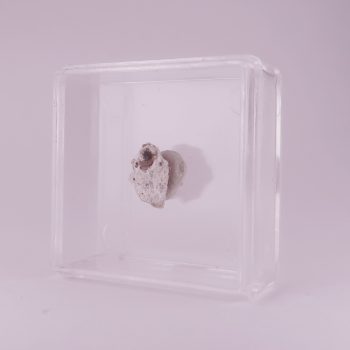
Bixbyite-(Mn) from Beaverhead, USA
£5.00 -
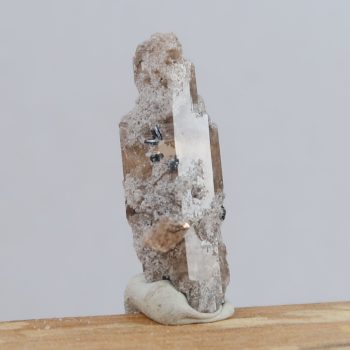

Topaz crystals with Bixbyite
Price range: £1.25 through £10.00
Information about Bixbyite
Bixbyite is a manganese iron oxide mineral forming as a primary accessory in highly evolved silica-rich rhyolites and in metamorphosed manganese ore deposits, and is collected primarily for the quality of its crystals – small but perfectly formed cubic to modified cubic black crystals with a bright submetallic lustre that sit in sharp contrast against the pale matrix of rhyolitic cavities.
The crystals typically express cube, octahedron, and dodecahedron faces in combination, and at their best are among the most geometrically precise of the manganese oxide minerals.
The most celebrated locality is the Thomas Range in Juab County, Utah, USA, where bixbyite crystals occur in topaz-bearing rhyolite cavities alongside red beryl, topaz, pseudobrookite, and garnet.
This same Thomas Range locality gives the collector community one of its most persistent naming confusions: bixbyite (the manganese iron oxide) and bixbite (red beryl, gem-quality red beryl from Utah) are both named for the same person, Maynard Bixby, but are entirely different minerals. For this reason, the name bixbite is now deprecated and the material should simply be called red beryl.
Fine specimens also come from the Postmasburg manganese district of the Northern Cape, South Africa, where bixbyite occurs in metamorphosed Precambrian manganese deposits alongside hausmannite, braunite, and sugilite.
The mineral is named in honour of Maynard Bixby (1853–1935), a Utah mineral collector and dealer who collected extensively in the Thomas Range and supplied specimens to mineralogists and museums.
Uses and History
Bixbyite was named for Maynard Bixby whose collecting work in the Utah desert brought this remote and mineral-rich locality to wider scientific attention.
The Thomas Range rhyolites are geologically unusual: highly evolved topaz rhyolites in which late magmatic fluids have concentrated fluorine, beryllium, manganese, and other elements into a suite of rare accessory minerals preserved in gas cavities (miarolitic pockets) within the lava. The bixbyite-topaz-red beryl assemblage of the Thomas Range has no precise equivalent elsewhere.
The naming tangle between bixbyite and bixbite (red beryl) is worth noting: red beryl from the Wah Wah Mountains of Utah (a different locality from the Thomas Range) was named bixbite, also honouring Maynard Bixby. The IMA has since discouraged the name bixbite for red beryl in favour of simply “red beryl” or “scarlet emerald” to avoid confusion with bixbyite – but bixbite persists in the gem trade. Maynard Bixby is one of very few people to have two mineral names derived from their surname.
Mineralogy
Distinguished from magnetite (also cubic black, but strongly magnetic – bixbyite is non-magnetic to weakly magnetic) by absence of strong magnetism and higher Mn content.
Distinguished from hausmannite (tetragonal, pseudo-octahedral, brownish-black) by cubic crystal form. XRD and electron microprobe for Mn:Fe ratio and definitive identification.
Hazards and Warnings
Manganese dust should not be chronically inhaled (occupational manganism is a known industrial hazard at high exposure levels), but normal handling of mineral specimens presents no significant risk. Wash hands after handling as good practice.
Almost all rocks, minerals (and, frankly, almost all other substances on earth) can produce toxic dust when cutting, which can cause serious respiratory conditions including silicosis. When cutting or polishing rocks, minerals, shells, etc, all work should be done wet to minimise the dust, and a suitable respirator or extraction system should be used.
Translations
Arabic:
Hindi:
Portuguese:
- Bixbiíta
Bengali:
Indonesian:
Punjabi:
English:
- Bixbyite
Italian:
- Bixbiite
Russian:
- Биксбиит
French:
- Bixbyite
Japanese:
- ビクスビ石
Spanish:
- Bixbiíta
German:
- Bixbyit
Korean:
Thai:
Gujurati:
Mandarin Chinese:
- 锰铁矿
Urdu: