
Beraunite
Beraunite is a secondary iron phosphate mineral which can form fantastic fibrous or acicular crystals.
Beraunite is likely primarily of interest to micromineral collectors.
Showing all 2 results
-
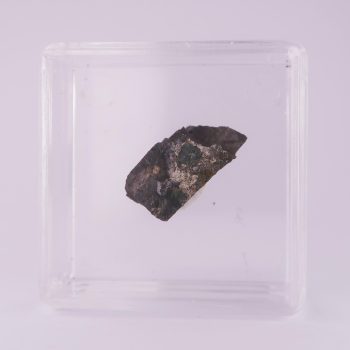
Beraunite and Ferristrunzite from Mont-des-Groseillers, Belgium
£7.50 -
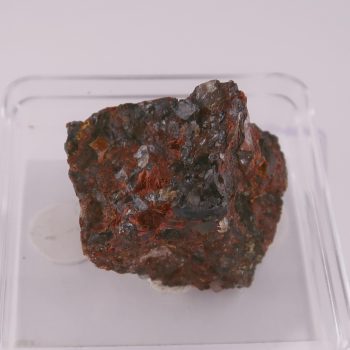

Beraunite from Mark Mine, Germany
£20.00
Information about Beraunite
Beraunite is a rare hydrated iron phosphate mineral, collected primarily for its attractive reddish to reddish-brown colour and its delicate radiating or spherical crystal clusters. It is an uncommon but popular phosphate species among specialists, particularly those who collect from granitic pegmatites.
It most commonly forms as small tabular or acicular crystals, typically arranged in radiating or spherulitic (ball-like) aggregates, and occasionally as disc-shaped concretions or crusts. It is typically reddish to dark reddish-brown in colour when oxidised – which is its usual condition in the field – though fresher material can appear dark greenish to greenish-brown. It has a vitreous lustre and is translucent to transparent in thin crystals.
Beraunite forms as a secondary mineral – that is, it develops through the weathering and alteration of pre-existing minerals – most commonly from the breakdown of iron-bearing primary phosphate minerals such as triphylite and lithiophyllite in granitic pegmatites, or in iron ore deposits and bog iron deposits where phosphate-rich groundwater is present.
A note on recent nomenclature: In 2022, the IMA formally redefined beraunite, clarifying a long-standing confusion in the mineral’s classification. The name beraunite is now reserved strictly for the fully oxidised, iron(III)-dominant species, which is always reddish in colour. The mixed-valence (partially reduced) green to greenish species – previously often also called beraunite – has been formally renamed ferroberaunite.
In short: if it is reddish, it is beraunite; if it is greenish, it is ferroberaunite. Older labels and collection data may not reflect this distinction, so collectors should be aware that some specimens previously catalogued as beraunite may need re-examination.
Uses and History
Beraunite has no industrial applications and is far too soft and uncommon for use in jewellery. It is collected purely as a mineral specimen.
The mineral was first described in 1840 by the German mineralogist August Breithaupt, from specimens collected at the Hrbek Mine near Beraun – now called Beroun – in Bohemia in the Czech Republic. It takes its name directly from that town. The type locality remains one of the best-known sources of the mineral.
Notable localities include the Hagendorf pegmatite near Pleystein in Bavaria, Germany, which has produced some of the finest and most richly coloured specimens; Rabenstein, also in Bavaria; the Palermo and Fletcher mines in New Hampshire, USA; several mines in the Black Hills of South Dakota, USA; Mangualde in Portugal; and the Anloua vivianite deposit in Cameroon, where beraunite has been found forming on the surfaces of enormous vivianite crystals – a striking and unusual association.
In France it has been recorded from several pegmatite localities including Montmins in Allier and La Fumade in Tarn. In England, ferroberaunite – the greenish relative described above – was formally described from the Gravel Hill Mine at Perranzabuloe in Cornwall, making that locality the type locality for the newly defined species.
Mineralogy
Hazards and Warnings
No specific health risks have been formally recorded for beraunite. Mineral collectors should wash their hands after handling specimens as a matter of good practice.
Almost all rocks, minerals (and, frankly, almost all other substances on earth) can produce toxic dust when cutting, which can cause serious respiratory conditions including silicosis. When cutting or polishing rocks, minerals, shells, etc, all work should be done wet to minimise the dust, and a suitable respirator or extraction system should be used.
Translations
Arabic:
Hindi:
Portuguese:
- Beraunita
Bengali:
Indonesian:
Punjabi:
English:
- Beraunite
Italian:
Russian:
French:
- Beraunite
Japanese:
Spanish:
- Beraunita
German:
- Beraunit
Korean:
Thai:
Gujurati:
Mandarin Chinese:
Urdu: