
Agardite
Agardite are rare earth members of the Mixite group. They are arsenate minerals and are typically named for their rare earth mineral content – eg Agardite-(Ce), Agardite-(Y).
They typically form as micro acicular crystals, and are of particular interest to micromount and systematic mineral collectors.
Showing all 4 results
-
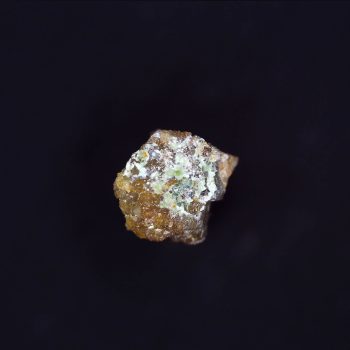
Agardite from Brandy Gill Mine, Cumbria
£20.00 -
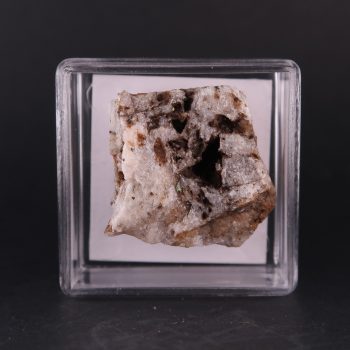

Agardite from Deer Hills, Cumbria
£20.00 -
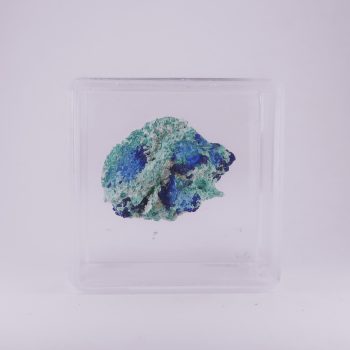
Agardite from Hilarion Mine, Greece
£20.00 -
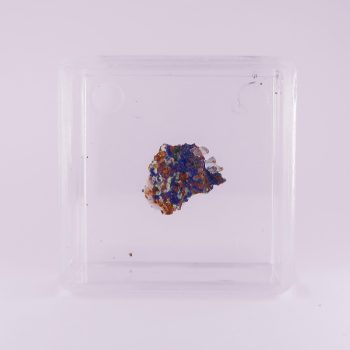
Agardite, Azurite, and Calcite from Christiana Mine, Greece
£15.00
Information about Agardite
Agardite typically forms fine, hair-like to needle-like crystals, often occurring in tufted sprays or radiating clusters. It is typically yellow-green to blue-green in colour, with a vitreous to silky lustre. Crystals are usually transparent to translucent.
The group consists of four recognised species – agardite-(Y), agardite-(Ce), agardite-(Nd), and agardite-(La) – named according to which rare earth element is dominant in their composition.
Agardite-(Y), containing yttrium, is by far the most commonly encountered. The group belongs to the wider mixite group, and agardite is closely related to mixite, zálesíite, and goudeyite.
Agardite forms in the oxidised, weathered zones of copper-rich ore deposits, where it develops as a secondary mineral alongside others such as adamite, limonite, malachite, and olivenite.
Uses and History
Agardite has no industrial applications and is too soft, toxic, and fragile for use in jewellery. It is collected purely for its striking colour and delicate crystal habit.
The mineral group was first characterised in 1969 by Dietrich, Orliac, and Permingeat, from specimens collected at the Bou Skour Mine in Morocco – the type locality for agardite-(Y). The group was named in honour of Jules Agard (1916-2003), a French geologist who contributed to geological survey work in Morocco and elsewhere.
Notable localities include the Hilarion Mine in Lavrion, Greece, the Clara Mine in the Black Forest, Germany, and various mines in Morocco, France, the Czech Republic, and the United States. It has also been recorded in smaller quantities in the United Kingdom.
Mineralogy
Typically yellow-green to blue-green; occasionally pale green or greenish-blue depending on the dominant rare earth element present.
Hazards and Warnings
Toxic mineral: contains arsenic and copper.
Mineral collectors should wash their hands after handling specimens, to avoid any exposure to potential toxins.
Almost all rocks, minerals (and, frankly, almost all other substances on earth) can produce toxic dust when cutting, which can cause serious respiratory conditions including silicosis. When cutting or polishing rocks, minerals, shells, etc, all work should be done wet to minimise the dust, and a suitable respirator or extraction system should be used.
Translations
Arabic:
Hindi:
Portuguese:
Bengali:
Indonesian:
Punjabi:
English:
Italian:
Russian:
- Агардит
French:
Japanese:
Spanish:
- Agardit
German:
- Agardit
Korean:
Thai:
Gujurati:
Mandarin Chinese:
Urdu: