
Willhendersonite
Willhendersonite is a rare zeolite species forming small, colourless to white crystals, chiefly sought after by zeolite specialists and micromount collectors.
It is often found in association with other zeolite minerals, especially phillipsite and thomsonite.
Showing the single result
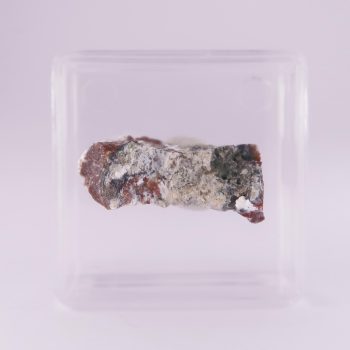
Information about Willhendersonite
Willhendersonite is an exceptionally rare calcium potassium aluminosilicate zeolite mineral, known from only a very small number of volcanic localities and collected almost exclusively by zeolite specialists and micromount enthusiasts. It forms tiny, colourless to white tabular crystals, usually only fractions of a millimetre across, and is best appreciated at magnification rather than in hand specimen.
It typically occurs as thin, square to rhombic tabular crystals, sometimes in spherical aggregates or fan-like groups, coating cavities in volcanic rocks. It is colourless to white, with a vitreous to pearly lustre, and is transparent to translucent. Most specimens require a loupe or low-power microscope to see the crystals at all – willhendersonite is firmly in micromount territory.
Willhendersonite is a member of the zeolite group, and is specifically a member of the chabazite-levyne subgroup, being isostructural with chabazite – meaning it shares the same fundamental crystal architecture as chabazite, with potassium and calcium occupying the large cation sites in the structure.
Like other zeolite minerals, it forms in the cavities and vesicles of volcanic rocks where silica-poor, calcium- and potassium-bearing hydrothermal fluids slowly deposit minerals at relatively low temperatures. It is closely related to chabazite and is sometimes found intergrown with it, which can make identification by eye essentially impossible.
Uses and History
Willhendersonite has no industrial or gemological applications. Like most members of the zeolite group, it is of scientific interest for its ion-exchange properties – zeolites can selectively absorb and release ions and molecules, a property exploited industrially in water softeners, catalysts, and molecular sieves – but willhendersonite itself is far too rare to have any practical application.
The mineral was first described in 1984 by Donald R. Peacor, P.J. Dunn, William B. Simmons, Ekkehart Tillmanns, and Reinhard X. Fischer, in a paper published in the American Mineralogist.
It was named in honour of William “Bill” A. Henderson Jr. (5 October 1932 – 20 April 2014) of Guilford, Connecticut, a chemist with the American Cyanamid Company and a lifelong mineral collector and contributor to the Mineralogical Record.
The story of the original specimen is an unusually personal one: in late 1980 Bill Henderson submitted a specimen to his friend P.J. Dunn that he had acquired several years earlier from Italian mineral dealer Gianni Porcellini of Rimini. The specimen turned out to be the key piece of evidence that established willhendersonite as a new species. Henderson’s central role in bringing the material to scientific attention led directly to the mineral being named in his honour, and he was later elected to the Micromounters Hall of Fame in 1997 in recognition of his decades of contribution to microscopic mineral collecting.
The original type material came from the Vispi quarry in San Venanzo, Terni Province, Italy. Notable localities include the Caspar quarry and the broader Eifel volcanic district in Germany; the San Venanzo and Colle Fabbri localities in Umbria, central Italy, where the mineral occurs in volcanic ultrabasic rocks and carbonatites; and the Stradner Kogel locality in Südoststeiermark, Austria.
No occurrences are known from the United Kingdom.
Mineralogy
Hazards and Warnings
No specific health risks have been formally recorded for willhendersonite. Mineral collectors should wash their hands after handling specimens as a matter of good practice.
Almost all rocks, minerals (and, frankly, almost all other substances on earth) can produce toxic dust when cutting, which can cause serious respiratory conditions including silicosis. When cutting or polishing rocks, minerals, shells, etc, all work should be done wet to minimise the dust, and a suitable respirator or extraction system should be used.
Translations
Arabic:
Hindi:
Portuguese:
- Willhendersonita
Bengali:
Indonesian:
Punjabi:
English:
- Willhendersonite
Italian:
- Willhendersonite
Russian:
- Вилхендерсонит
French:
- Willhendersonite
Japanese:
Spanish:
- Willhendersonita
German:
- Willhendersonit
Korean:
Thai:
Gujurati:
Mandarin Chinese:
Urdu: