
Volborthite
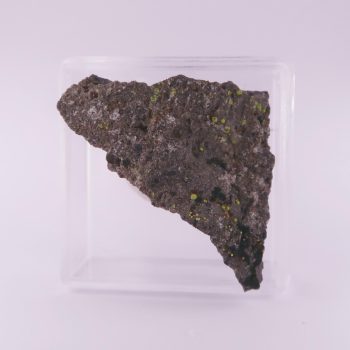
Volborthite is a yellow-green copper vanadate mineral found in oxidised copper deposits. It forms flaky or fibrous masses.
Showing the single result
Information about Volborthite
Volborthite is a rare copper vanadate mineral, forming small but attractively coloured platy crystals and rosette aggregates in the oxidised zones of vanadium-bearing copper ore deposits. It is an uncommon collector’s mineral with an unusually wide geographical distribution for a rare species, and has attracted interest from an unexpected quarter – condensed matter physicists studying exotic quantum phenomena.
It typically occurs as thin platy, scale-like, or lenticular crystals, commonly arranged in rosette-like aggregates or as crusts partially coating its host rock. Crystals are typically olive-green to yellow-green in colour, occasionally pale yellow or brownish-green, with a vitreous to pearly lustre.
Most specimens are best appreciated under magnification – individual crystals are rarely more than 1-2 mm across – though good-quality specimens from the best localities show neat, well-defined rosettes of glassy green scales on their matrix. It is visually very similar to vésigniéite, a barium copper vanadate, with which it can easily be confused in hand specimen.
Volborthite forms as a secondary mineral – that is, through the weathering and alteration of pre-existing copper and vanadium-bearing minerals – in the near-surface oxidised zones of hydrothermal ore deposits where vanadium is present. It occurs alongside minerals such as brochantite, malachite, atacamite, chrysocolla, tangeite, baryte, and gypsum.
It is also known from sandstone-hosted uranium-vanadium deposits of the Colorado Plateau type, where it occurs with carnotite and other vanadates. In this setting it was historically mistaken for a radioactive mineral by rockhounds, though volborthite itself contains no uranium or thorium and is non-radioactive – it simply shares an environment with uranium minerals.
Uses and History
Volborthite has no industrial or gemological applications. It is a minor ore of vanadium in theory but far too uncommon to be mined commercially. Its principal significance is as a scientific and collector’s specimen.
The mineral was first described in 1838 by the German-Russian mineralogist and chemist Heinrich Hess, from specimens collected at the Sofronovskii Mine in Perm Oblast in the Middle Urals of Russia – its type locality. It was initially named knaufite, after a Dr Knauf who first observed the material, but the name was shortly afterwards changed to volborthite in honour of Alexander Fedorovich Volborth (22 January 1800 – 17 March 1876), a Russian palaeontologist based at the Imperial Academy of Sciences in St Petersburg, who had first drawn attention to the mineral. Volborth is also commemorated in the names of at least ten fossil species, reflecting his considerable contributions to Russian palaeontology.
Notable localities include the Ural Mountains of Russia, the type region; the Scrava Mine in eastern Liguria, Italy, from which a crystal structure refinement was published in 1988; Wheal Edward at St Just in Cornwall, England, one of the few confirmed British occurrences, where volborthite has been found in small quantities on specimens from the oxidised zone; the Carlin Gold Mine in Elko County, Nevada, USA; numerous localities on the Colorado Plateau in Arizona, Utah, and New Mexico, USA, where it occurs in sandstone-hosted uranium-vanadium deposits; Inuyama in Aichi Prefecture, Japan, a long-established Japanese locality known since the mid-20th century; Paull’s Consolidated Mine in South Australia; localities in Namibia; and Příbram in the Czech Republic.
In Wales, volborthite has been recorded from several localities in the Central Wales Orefield, including Dolyhir Quarry at Old Radnor in Powys, Siglenlas Mine near Llangurig in Powys, Mwyndy Mine at Llantrisant in Rhondda Cynon Taf, and Gwaith yr Afon Mine near Goginan in Ceredigion, where it occurs in small quantities in the oxidised zones of lead-zinc-copper vein systems.
Mineralogy
Hazards and Warnings
Toxic mineral: contains copper and vanadium. Vanadium compounds are toxic and should not be ingested or inhaled. Mineral collectors should wash their hands thoroughly after handling specimens, to avoid any exposure to potential toxins.
Almost all rocks, minerals (and, frankly, almost all other substances on earth) can produce toxic dust when cutting, which can cause serious respiratory conditions including silicosis. When cutting or polishing rocks, minerals, shells, etc, all work should be done wet to minimise the dust, and a suitable respirator or extraction system should be used.
Translations
Arabic:
Hindi:
Portuguese:
- Volborthita
Bengali:
Indonesian:
Punjabi:
English:
- Volborthite
- Knaufite (original name, now disused)
Italian:
- Volborthite
Russian:
- Фольбортит
French:
- Volborthite
Japanese:
- ボルボルト石
Spanish:
- Volborthita
German:
- Volborthit
Korean:
Thai:
Gujurati:
Mandarin Chinese:
- 水钒铜矿
Urdu: