
Veszelyite
Veszelyite is a bright blue copper-zinc phosphate mineral. It forms small, sharply shaped crystals which are primarily of interest to micro mineral collectors.
Showing the single result
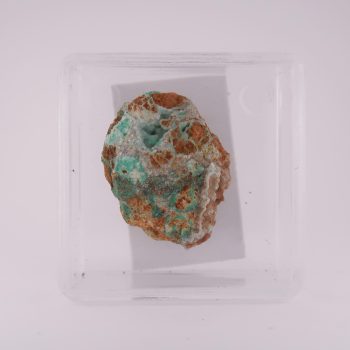
Information about Veszelyite
Veszelyite is a rare hydrated copper zinc phosphate mineral, forming small but beautifully coloured crystals in the oxidised zones of base metal ore deposits.
It is a collectors’ mineral with no commercial applications, valued for its striking blue-green colour, good luster, and the fact that well-crystallised specimens from the best localities are genuinely impressive at hand-specimen scale despite the small size of individual crystals.
It typically occurs as short prismatic to tabular crystals, sometimes pseudo-octahedral in outline, occasionally aggregated into radiating or granular groups. It is typically emerald-green to blue-green or green-blue in colour, with a vitreous lustre and transparent to translucent crystals. The combination of vivid colour and bright luster makes fine specimens visually striking – one description compares the crystals to green sprinkles scattered on a surface, catching the light individually. Crystals from the Black Pine Mine in Montana – the best-known source worldwide – can reach 5 mm or more and are among the finest small-crystal specimens of any secondary copper phosphate.
Veszelyite forms only under a relatively narrow set of chemical conditions in the near-surface oxidised zone of base metal deposits: copper, zinc, and phosphate must all be available in solution simultaneously alongside sufficient water and hydroxyl, and the local chemistry must be at the right balance of acidity and oxidation state for the mineral to crystallise rather than forming one of the commoner copper or zinc secondary minerals instead. This combination of requirements makes it rare and highly localised even within deposits where all the right elements are present.
It is the phosphate analogue of arsenoveszelyite, in which arsenate replaces phosphate, and is closely related to kipushite – a name formerly applied to veszelyite from Kipushi in the DRC before it was formally synonymised with veszelyite in 1974.
Uses and History
Veszelyite has no industrial or gemological applications. It is too soft and too uncommon for use in jewellery, and is collected purely as a mineral specimen.
The mineral was first described in 1874 by the Austrian mineralogist Albrecht Schrauf, from specimens collected at Ocna de Fier in the Caraș-Severin County of the Banat region of Romania – its type locality. The original description was published in the proceedings of the Imperial Academy of Sciences in Vienna. It was named in honour of Ágost (Gusztáv) Veszely (1821-1879), a Hungarian mining engineer associated with the locality, who is credited with discovering the mineral.
The finest collectable specimens come from the Black Pine Mine in Philipsburg, Granite County, Montana, USA – a gold, silver, and copper mine in operation since 1882 that has produced the most celebrated veszelyite crystals known, including gemmy blue-green examples to 5 mm.
Kipushi in Haut-Katanga, DRC – one of the great base metal deposits of central Africa – is the other classic locality, from which the now-disused name “kipushite” was derived. Other significant occurrences include Moravica (Moravicza) in Romania, close to the type locality; Broken Hill (Kabwe) in Zambia; Kamioka and Arakawa in Japan; and Yunnan Province in China.
In Scotland, veszelyite was first confirmed from Wanlockhead in Dumfries and Galloway by D.I. Green in 1990, published in the UK Journal of Mines and Minerals – the first confirmed British occurrence. Veszelyite has also been recorded from the Ting Tang Mine, Cornwall, documented by M. Rumsey in the Russell Society Newsletter in 2004. No Welsh occurrences are currently recorded on Mindat.
Mineralogy
Hazards and Warnings
Toxic mineral: contains copper and zinc. Mineral collectors should wash their hands after handling specimens as a matter of good practice.
Almost all rocks, minerals (and, frankly, almost all other substances on earth) can produce toxic dust when cutting, which can cause serious respiratory conditions including silicosis. When cutting or polishing rocks, minerals, shells, etc, all work should be done wet to minimise the dust, and a suitable respirator or extraction system should be used.
Translations
Arabic:
Hindi:
Portuguese:
- Veszelyita
Bengali:
Indonesian:
Punjabi:
English:
- Veszelyite
- Kipushite (disused synonym)
Italian:
- Veszelyite
Russian:
- Весцелиит
French:
- Veszelyite
Japanese:
- ヴェゼリー石
Spanish:
- Veszelyita
German:
- Veszelyit
Korean:
Thai:
Gujurati:
Mandarin Chinese:
- 磷砷锌铜矿
Urdu: