
Tarbuttite
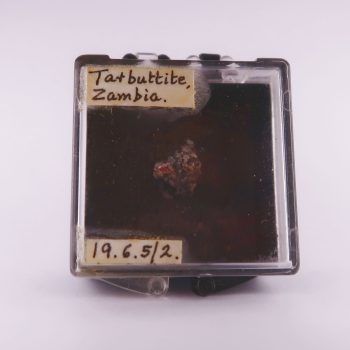
Tarbuttite is a zinc phosphate more commonly encountered as pale, colourless to whitish crystals or crystalline crusts rather than the well-known pink examples.
Its relative scarcity ensures it remains an attractive addition for species collectors.
Showing the single result
Information about Tarbuttite
Tarbuttite is a rare secondary zinc phosphate mineral forming in the oxidised zones of zinc-bearing ore deposits. It is one of those minerals that covers a surprisingly wide colour range for a single species – white, yellow, red, green, brown, and colourless are all recorded, with the colour depending on which trace impurities are present – but it is most often encountered in dull white to pale yellowish encrusting forms that lack obvious visual drama.
The finest crystallised specimens are genuinely attractive, however, and the Skorpion Mine in Namibia has produced colourless to pale material that is among the best the species has to offer.
It typically forms as stout to short prismatic crystals, often with striated or fluted surfaces, either individually or in aggregates and encrusting masses. Individual crystals can reach 2 cm at the finest localities. Copper contamination causes green colouring; iron hydroxide contamination causes yellow, red, or brown tones; clean material is colourless or white. The lustre is vitreous and crystals are transparent to translucent depending on colour intensity.
Tarbuttite belongs to the olivenite group and is one of a small number of phosphate minerals that form specifically in the oxidised zones of zinc ore deposits, requiring both zinc and phosphate in solution simultaneously. It is often associated with smithsonite, hemimorphite, hopeite, and parahopeite.
One source has noted it forming in ancient caves beneath layers of bat guano, where the prolonged accumulation of phosphate-rich droppings provides the phosphate source – an informal reminder that tarbuttite, like minyulite, occupies an unusual intersection between geology and biology.
Uses and History
Tarbuttite has no industrial or gemological applications. It is collected purely as a mineral specimen.
The mineral was first described in 1907 by the British mineralogist George Thurland Prior, from specimens collected at the Broken Hill Mine (Kabwe) in what is now Zambia – its type locality. It was named in honour of Percy Coventry Tarbutt (1873-1943), a mining entrepreneur and director of the Broken Hill Exploration Company who supplied specimens for study.
The finest collector specimens come from the Skorpion Mine near Rosh Pinah in the Karas Region of Namibia, which has produced colourless to pale crystallised material considered the best for the species; and from the type locality at Kabwe (Broken Hill) in Zambia, where crystals to 2 cm occur. The Reaphook Hill locality near Blinman in the Flinders Ranges, South Australia, and Broken Hill in New South Wales, Australia, are other documented sources. No occurrences are currently confirmed from the United Kingdom.
Mineralogy
Hazards and Warnings
Toxic mineral: contains zinc and phosphate. Mineral collectors should wash their hands after handling specimens as a matter of good practice.
Almost all rocks, minerals (and, frankly, almost all other substances on earth) can produce toxic dust when cutting, which can cause serious respiratory conditions including silicosis. When cutting or polishing rocks, minerals, shells, etc, all work should be done wet to minimise the dust, and a suitable respirator or extraction system should be used.
Translations
Arabic:
Hindi:
Portuguese:
- Tarbuttita
Bengali:
Indonesian:
Punjabi:
English:
- Tarbuttite
Italian:
- Tarbuttite
Russian:
- Тарбуттит
French:
- Tarbuttite
Japanese:
Spanish:
- Tarbuttita
German:
- Tarbuttit
Korean:
Thai:
Gujurati:
Mandarin Chinese:
Urdu: