
Strashimirite
Strashimirite is an uncommon copper arsenate mineral which typically occurs as a secondary mineral in the oxidising zone of copper arsenide minerals.
It forms quality micro specimens, including radiating spherulites.
Showing all 2 results
-
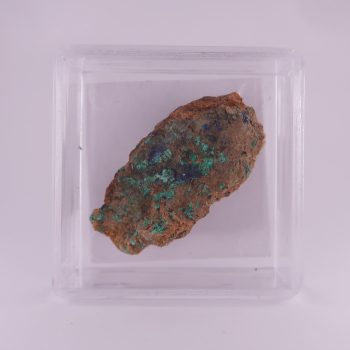
Parnauite and Strashimirite from Herren adit, Austria
£20.00 -
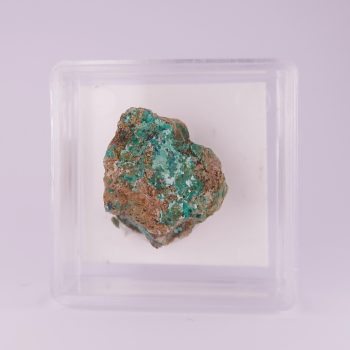

Parnauite and Strashimirite from Schwarzleo mining district, Austria
£15.00
Information about Strashimirite
Strashimirite is an uncommon secondary copper arsenate mineral, forming small pale green to white spherulitic and fibrous aggregates in the oxidised zones of copper-arsenic bearing ore deposits. It is primarily a micromount mineral – most specimens require magnification to fully appreciate the crystal detail – but it has a wide distribution for a relatively obscure species and is known from dozens of localities across Europe and North America.
It typically occurs as compact spherulitic aggregates of radially arranged fibrous to acicular crystals, usually pale green to whitish-green or white, with a greasy to pearly lustre that is somewhat dull at macroscale but shows more character at magnification. The crystal form is monoclinic and individual crystals are tabular to elongate, though these are usually only visible within the spherulitic masses under a microscope.
Strashimirite forms in the shallow oxidised zone of copper ore deposits where arsenic is present in the mineralogy – either from arsenopyrite or from primary copper arsenide minerals – and where circulating groundwater provides the chemical environment for secondary arsenate minerals to crystallise. It is closely related to parnauite, a fibrous copper arsenate sulphate, with which it can appear visually similar, and to olivenite and other members of the secondary copper arsenate family.
Its crystal structure was fully solved comparatively recently, in 2015, leading to a revised formula, space group, and unit cell parameters – meaning older references may cite an outdated formula.
Uses and History
Strashimirite has no industrial or gemological applications. It is collected as a scientific specimen.
The mineral was first discovered in 1960 at the Zapachitsa copper deposit in Svoge, Sofia Oblast, Bulgaria, by the Bulgarian mineralogist Jordanka Mincheva-Stefanova, and formally described in a paper published in 1968 in the Zapiski Vserossiyskogo Mineralogicheskogo Obshchestva. It was named in honour of Strashimir Georgiev Dimitrov (22 August 1892 – 26 April 1960), Professor of Mineralogy and Petrography at Sofia University and Head of the Department of Mineralogy and Petrography at the Bulgarian Academy of Sciences, who died in the same year the mineral was discovered.
The best collector specimens come from the Clara Mine at Oberwolfach in the Black Forest, Germany, which has produced the most photographed material and is also a classic locality for many other rare secondary minerals; and from the Majuba Hill Mine in Pershing County, Nevada, USA, which is the primary source of specimens on the collector market and occurs there alongside azurite, malachite, and other copper secondary minerals.
The type locality at Zapachitsa in Bulgaria is documented but specimens are rarely seen on the market.
In the UK, we do have a few occurrences; including the Penberthy Croft Mine and several other mines in Cornwall, the Old Sandbed Mine in Cumbria, and New Cliffe Hill Quarry in Leicestershire. However, specimens from these localities are very uncommon.
Mineralogy
Hazards and Warnings
Toxic mineral: contains copper and arsenic. Arsenic compounds are highly toxic. Mineral collectors should wash their hands thoroughly after handling specimens, avoid any contact with the mouth, and never inhale dust from specimens.
Almost all rocks, minerals (and, frankly, almost all other substances on earth) can produce toxic dust when cutting, which can cause serious respiratory conditions including silicosis. When cutting or polishing rocks, minerals, shells, etc, all work should be done wet to minimise the dust, and a suitable respirator or extraction system should be used.
Translations
Arabic:
Hindi:
Portuguese:
- Strashimirita
Bengali:
Indonesian:
Punjabi:
English:
- Strashimirite
Italian:
- Strashimirite
Russian:
- Страшимирит
French:
- Strashimirite
Japanese:
Spanish:
- Strashimirita
German:
- Strashimirit
Korean:
Thai:
Gujurati:
Mandarin Chinese:
Urdu: