
Straczekite
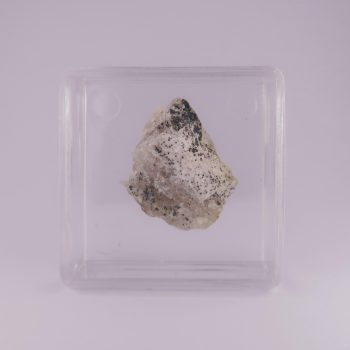
Straczekite is a calcium barium potassium vanadate which forms interesting micro crystals, often in ‘lath’ like fibres, or radiating groups.
Primarily of interest to micromineral collectors.
Showing the single result
Information about Straczekite
Straczekite is an exceptionally rare calcium barium potassium vanadate mineral and one of a small family of mixed-valence vanadium oxide minerals known as vanadium bronzes – a group defined not by their geological setting but by their unusual crystal chemistry, in which vanadium exists simultaneously in two different oxidation states within the same structure.
It is known from only a handful of localities worldwide and is firmly a micromount and scientific specimen, with crystals that are small, dark, and best appreciated under magnification rather than in hand specimen.
It forms soft, thin laths of dark greenish-black crystals up to around 0.5 mm in length, typically in fibrous masses and seams rather than as isolated crystals.
Uses and History
Straczekite has no industrial or gemological applications. It is of scientific interest as a natural example of a vanadium bronze structure and is collected as an extreme rarity.
The mineral was formally described in 1984 by Howard T. Evans Jr., Gordon Nord, John Marinenko, and Charles Milton, in a paper published in Mineralogical Magazine – the journal of the Mineralogical Society of Great Britain and Ireland. It was named in honour of John A. Straczek (13 September 1914 – 2 November 2003), Chief Geologist of the Union Carbide Corporation, who made the study of the mineral possible by providing access to the deposit.
The name is pronounced “strā-chek-ite” following the Polish origin of the surname it honours.
The sole confirmed locality at the time of the minerals description – and still the primary source of any specimens that reach the collector market – is the North Wilson pit of the Union Carbide Mine at Wilson Springs (formerly Potash Sulfur Springs) in Garland County, Arkansas, USA, where straczekite occurs as a rare secondary mineral in fibrous seams alongside other vanadium minerals in altered alkalic igneous and metamorphosed sedimentary rocks near the Magnet Cove intrusive complex.
Mindat currently records three additional localities: a mine in Utah, a mine in Arizona, and a locality in Germany – making the total confirmed count four worldwide. No occurrences are recorded from the United Kingdom.
Mineralogy
Hazards and Warnings
Toxic mineral: contains vanadium and barium. Both vanadium compounds and barium compounds are toxic. Mineral collectors should wash their hands thoroughly after handling specimens and avoid inhaling any dust.
Almost all rocks, minerals (and, frankly, almost all other substances on earth) can produce toxic dust when cutting, which can cause serious respiratory conditions including silicosis. When cutting or polishing rocks, minerals, shells, etc, all work should be done wet to minimise the dust, and a suitable respirator or extraction system should be used.
Translations
Arabic:
Hindi:
Portuguese:
- Straczekita
Bengali:
Indonesian:
Punjabi:
English:
- Straczekite
Italian:
- Straczekite
Russian:
- Страчекит
French:
- Straczekite
Japanese:
Spanish:
- Straczekita
German:
- Straczékit
Korean:
Thai:
Gujurati:
Mandarin Chinese:
Urdu: