
Shortite
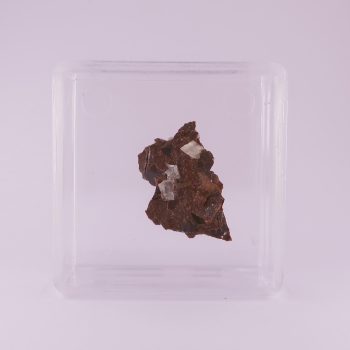
Shortite is a sodium calcium carbonate typically forming colourless to pale granular masses or simple crystals.
It isn’t something that’ll find a home in many collections, to be honest – it is generally collected for completeness within evaporite mineral collections.
Showing the single result
Information about Shortite
Shortite is a rare sodium calcium carbonate mineral – one of the very few anhydrous carbonate minerals to contain both sodium and calcium together – and one that is almost entirely confined to a single remarkable geological environment: the Eocene oil shale sequences of the Green River Formation in Wyoming, USA, where it occurs in the lahaite zone of the Laney Member as pale yellow to colourless tabular crystals of considerable clarity and beauty.
It is a scientifically significant mineral – its discovery helped establish the geochemistry of hypersaline alkaline lake deposits – and the Green River specimens are of genuine quality for a carbonate mineral.
It forms flat, wedge-shaped to rhombic tabular crystals, often with prominently striated faces, and typically colourless to pale yellow or pale orange-yellow, with a vitreous lustre and transparent to translucent quality. Crystals range from millimetre-scale to a centimetre or more in exceptional examples.
The mineralogy of the Green River Formation is unusual because the lake that deposited these sediments – an enormous, shallow, hypersaline lake that existed across what is now Wyoming, Colorado, and Utah approximately 50 million years ago – was alkaline rather than normal seawater chemistry, allowing sodium carbonate minerals to form that do not occur in ordinary marine or continental sedimentary settings.
Shortite belongs to a small group of sodium carbonate minerals that also includes trona, nahcolite, and gaylussite – all of which occur in alkaline lake and evaporite deposits. It is characterised by a particularly tight, dense crystal structure relative to most carbonates, which makes it more resistant to hydration than minerals like trona and natron.
Uses and History
Shortite has no industrial or gemological applications. It is collected as a mineral specimen.
The mineral was first described in 1939 from drill core samples in Sweetwater County, Wyoming. It was named in honour of Maxwell Naylor Short (1889-1952), Professor of Economic Geology at the University of Arizona and the author of several influential works on ore microscopy and economic geology.
The main collector locality for shortite is the Green River Formation itself, specifically the Eocene oil shales of Sweetwater County, Wyoming, and the adjacent Colorado and Utah portions of the formation.
There are also finds from the Poudrette Quarry of Canada.
Mineralogy
Hazards and Warnings
No specific health risks have been recorded for shortite. Mineral collectors should wash their hands after handling specimens as a matter of good practice.
Almost all rocks, minerals (and, frankly, almost all other substances on earth) can produce toxic dust when cutting, which can cause serious respiratory conditions including silicosis. When cutting or polishing rocks, minerals, shells, etc, all work should be done wet to minimise the dust, and a suitable respirator or extraction system should be used.
Translations
Arabic:
Hindi:
Portuguese:
- Shortita
Bengali:
Indonesian:
Punjabi:
English:
- Shortite
Italian:
- Shortite
Russian:
French:
- Shortite
Japanese:
Spanish:
- Shortita
German:
- Shortit
Korean:
Thai:
Gujurati:
Mandarin Chinese:
Urdu: