
Serandite
Serandite is a pink to salmon-coloured mineral found in alkaline rocks. It forms long, slender crystals.
Showing the single result
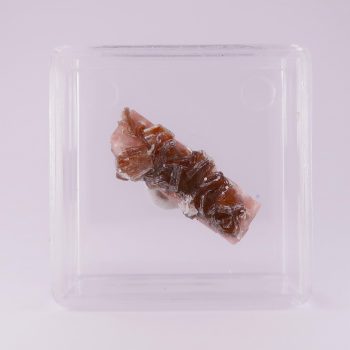
Information about Serandite
Serandite is a rare sodium manganese calcium silicate mineral of the pectolite group, prized by collectors for its extraordinary combination of colour and translucency – the finest specimens from Mont Saint-Hilaire in Quebec display a salmon-pink to deep orange-red transparency that is genuinely spectacular and entirely distinctive within the silicate minerals.
Along with tugtupite, eudialyte, and the pink sodalite from the same locality, serandite is one of the emblematic species of the Mont Saint-Hilaire complex, and is among the most interesting of all mineral species found in that extraordinary site.
It typically forms short prismatic to tabular crystals with a distinctive deep salmon to orange-pink colour, transparent to translucent, with a vitreous to silky lustre. The colour derives from manganese, with the intensity deepening as the manganese content increases relative to calcium.
Crystals up to 5 cm are known from the finest Mont Saint-Hilaire examples. It belongs to the pectolite group – a group of chain silicates in which pectolite (calcium-dominant) and serandite (manganese-dominant) form a complete solid-solution series, with intermediate compositions showing transitional colours between serandite’s salmon-red and pectolite’s white or grey.
Uses and History
Serandite has no industrial applications. Exceptionally transparent material from Mont Saint-Hilaire has rarely been faceted as a collector’s gemstone, though the softness and perfect cleavage of the pectolite group make cutting and wearing impractical.
The mineral was first described in 1931 by the French mineralogist Alfred Lacroix from specimens collected at Rouma Island in the Los Islands group off the coast of French Guinea (now Guinea), West Africa – its type locality. It was named by Lacroix in honour of J.M. Sérand, a lighthouse keeper on Rouma Island, collector of West African minerals who provided specimens for study.
Lacroix (1863-1948) was one of the most prolific descriptive mineralogists of his era, responsible for descriptions of hundreds of new mineral species and varieties, particularly from French colonial territories and from the volcanic geology of France and its overseas possessions.
The finest collector specimens by wide consensus come from Mont Saint-Hilaire (also known as Rouville County) in Quebec, Canada, where the alkaline intrusive complex has produced serandite crystals of outstanding clarity, size, and colour in association with natrolite, aegirine, analcime, and dozens of other rare alkaline silicate minerals.
This locality is considered by many specialists to be the single most mineralogically diverse locality on earth, with over 400 mineral species confirmed. The Los Islands type locality in Guinea is documented but material from there is rarely seen on the collector market. No occurrences are recorded from the United Kingdom.
Mineralogy
Hazards and Warnings
No specific health risks have been recorded for serandite. Mineral collectors should wash their hands after handling specimens as a matter of good practice.
Almost all rocks, minerals (and, frankly, almost all other substances on earth) can produce toxic dust when cutting, which can cause serious respiratory conditions including silicosis. When cutting or polishing rocks, minerals, shells, etc, all work should be done wet to minimise the dust, and a suitable respirator or extraction system should be used.
Translations
Arabic:
Hindi:
Portuguese:
- Serandita
Bengali:
Indonesian:
Punjabi:
English:
- Serandite
Italian:
- Serandite
Russian:
- Серандит
French:
- Sérandite
Japanese:
- セランダイト
Spanish:
- Serandita
German:
- Serandit
Korean:
Thai:
Gujurati:
Mandarin Chinese:
Urdu: