
Senarmontite
Senarmontite is an antimony trioxide mineral which occurs as a secondary mineral due to oxidation of stibnite.
It can form quality ‘champagne’ coloured crystals, but is usually colourless.
Showing the single result
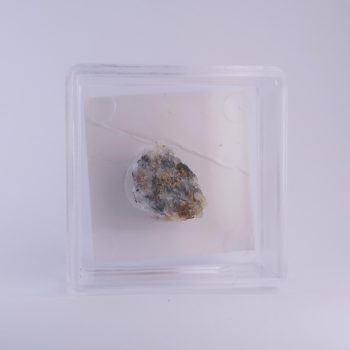
Information about Senarmontite
Senarmontite is one of only two naturally occurring antimony trioxide minerals – the other being the orthorhombic polymorph valentinite – and forms as a secondary oxidation product in antimony ore deposits, where it occurs as colourless to white cubic crystals and octahedra of considerable clarity and optical quality.
The finest specimens are genuinely attractive: sharp octahedral crystals with an adamantine lustre and good transparency, sitting on stibnite matrix, are among the better examples in the class of secondary oxide minerals.
It crystallises in the cubic system, forming octahedra, cubes, and combinations, often well-formed and sometimes with curved faces. Crystals are typically colourless to greyish-white or pale yellowish, with a bright adamantine to sub-adamantine lustre and refractive index high enough to give a noticeable dispersion. It is soft and relatively light for an antimony mineral.
Uses and History
Senarmontite has no significant industrial applications in its natural mineral form; antimony trioxide is manufactured synthetically at scale and used extensively as a flame retardant synergist in plastics, textiles, and electronics. The natural mineral is collected purely as a specimen.
The mineral was named by J. D. Dana in 1851 after the French mineralogist Henri Hureau de Sénarmont, a Professor of Mineralogy at the School of Mines in Paris, who first described the mineral.
The mineral was first described from specimens at the Djebel Hamimat antimony deposit in Algeria – its type locality.
The finest collector specimens come from the Djebel Hamimat (Ain Kerma) antimony mine in Constantine Province, Algeria, which has produced large and well-formed octahedral crystals on stibnite considered among the best of the species; and from Pereta in Grosseto Province, Tuscany, Italy, another classic antimony locality. Notable specimens are also known from Nerchinsk (Nerchinskiy Zavod) in Transbaikalia, Russia; the Costerfield mine in Victoria, Australia; and San Luis Potosí in Mexico.
There are several localities known in the UK, with probably the best known being Knipe Mine in Scotland.
Mineralogy
Hazards and Warnings
Toxic mineral: contains antimony. Antimony compounds are toxic. Mineral collectors should wash their hands thoroughly after handling specimens, avoid any contact with the mouth, and avoid generating dust. Antimony trioxide is classified as a possible carcinogen (Group 2B) by the IARC.
Almost all rocks, minerals (and, frankly, almost all other substances on earth) can produce toxic dust when cutting, which can cause serious respiratory conditions including silicosis. When cutting or polishing rocks, minerals, shells, etc, all work should be done wet to minimise the dust, and a suitable respirator or extraction system should be used.
Translations
Arabic:
Hindi:
Portuguese:
- Senarmontita
Bengali:
Indonesian:
Punjabi:
English:
- Senarmontite
Italian:
- Senarmontite
Russian:
- Сенармонтит
French:
- Sénarmontite
Japanese:
- セナルモンタイト
Spanish:
- Senarmontita
German:
- Senarmontit
Korean:
Thai:
Gujurati:
Mandarin Chinese:
Urdu: