
Sellaite
Sellaite is a colourless to white magnesium fluoride mineral. It has a glassy appearance and forms small crystals.
Showing the single result
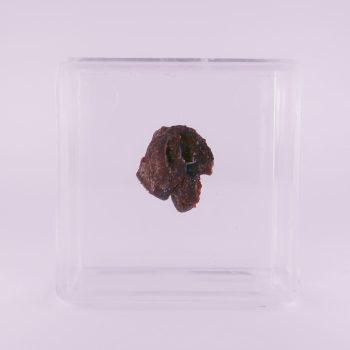
Information about Sellaite
Sellaite is a very rare magnesium fluoride mineral – the natural form of the compound MgF2 – occurring in a pleasingly diverse range of geological settings from Alpine glacial moraines to fumaroles on Vesuvius to metamorphic magnesite deposits in Brazil, but never in abundance at any of them. It is primarily a scientific specimen, though the Brumado deposits in Brazil have yielded colourless prismatic crystals large enough to be genuinely attractive, and a tiny amount of gem-quality material has been faceted from that source.
It forms as clear to white prismatic crystals, sometimes fibrous or as radiating aggregates, with a vitreous lustre and moderate hardness for a fluoride mineral. The crystal system is tetragonal.
Sellaite forms in diverse environments wherever magnesium and fluorine are simultaneously available: in evaporite deposits, in volcanic fumarolic incrustations, in metamorphic magnesite deposits where fluids have introduced fluorine, and in sodic alkalic granites. Despite being structurally well-characterised and industrially important as a synthetic compound, natural sellaite remains uncommon and most commercially useful magnesium fluoride is produced synthetically.
A curious historical footnote: in 1886 the Italian naturalist Arcangelo Scacchi described a mineral from Vesuvian lava that he called belonesite and thought was magnesium molybdate. The Italian mineralogist Ferruccio Zambonini demonstrated in 1899 that Scacchi’s belonesite was in fact sellaite all along, resolving a thirteen-year nomenclatural ghost.
Uses and History
Natural sellaite has no economically significant uses – the magnesium fluoride needed for optics, anti-reflective coatings on camera lenses and telescope mirrors, and the manufacture of polarising prisms is produced synthetically.
Transparent MgF2 is valued in optics because it remains transparent across an unusually broad range of wavelengths from deep ultraviolet through to mid-infrared – a range no glass can match – and synthetic MgF2 crystals grown by the Stockbarger method are used in high-performance optical instruments.
The mineral was first scientifically described in 1868-1869 by the Italian-German mineralogist Johann (Giovanni) Strüver, from specimens collected in the Gébroulaz glacier moraine in the Savoie Alps of France, where it occurred in Triassic evaporite clasts transported by glacial ice. It was named in honour of Quintino Sella (1827-1884), an Italian mining engineer, mineralogist, crystallographer, and – later in life – prominent politician who served three times as Minister of Finance for the Kingdom of Italy.
The finest collector specimens come from the magnesite mines at Brumado in Bahia, Brazil (particularly the Pedra Preta mine and the Pomba pit at Serra das Éguas), which have yielded colourless prismatic crystals considered the best of species and the source of the only confirmed facetable material. Mount Bischoff in Tasmania, Australia, is another well-documented locality.
European occurrences include the type locality in the Savoie Alps; the Bleicherode evaporite in the Harz region of Germany; fumarolic deposits at Vesuvius and Etna in Italy; and a small occurrence in sodic alkali granite near Gjerdingen in Norway. The Carrara marble quarries in Tuscany, Italy, also record sellaite.
No confirmed occurrences are currently on record from the United Kingdom.
Mineralogy
Hazards and Warnings
Fluoride mineral. As a fluoride compound, sellaite dust should not be inhaled. Fluoride ions are toxic. Handle with care and wash hands after contact.
Almost all rocks, minerals (and, frankly, almost all other substances on earth) can produce toxic dust when cutting, which can cause serious respiratory conditions including silicosis. When cutting or polishing rocks, minerals, shells, etc, all work should be done wet to minimise the dust, and a suitable respirator or extraction system should be used.
Translations
Arabic:
Hindi:
Portuguese:
- Selaíta
Bengali:
Indonesian:
Punjabi:
English:
- Sellaite
Italian:
- Sellaite
Russian:
- Селлаит
French:
- Sellaïte
Japanese:
Spanish:
- Selaíta
German:
- Sellait
Korean:
Thai:
Gujurati:
Mandarin Chinese:
Urdu: