
Mullite
Mullite is a hard, grey or white mineral formed at high temperatures. It is primarily of interest to micro mineral collectors for its fine sprays of crystals.
Showing all 3 results
-
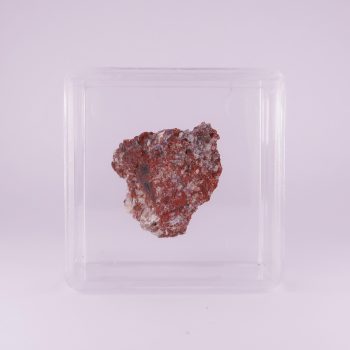
Cordierite and Mullite from Bellerberg Volcano, Germany
£7.50 -
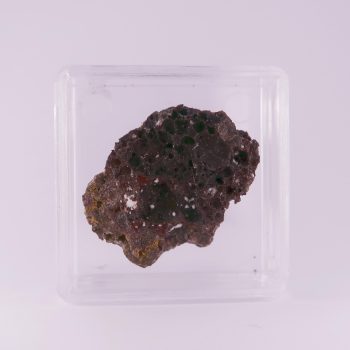

Mullite and Topaz from Emmelberg, Germany
£10.00 -
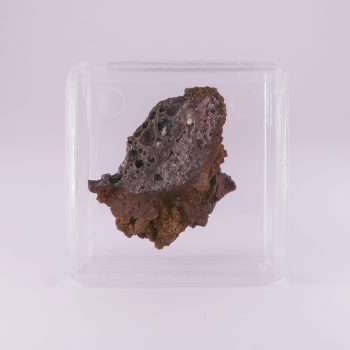
Mullite from Emmelberg, Germany
£6.50
Information about Mullite
Mullite is one of mineralogy’s more quietly remarkable entries – a mineral that most people have encountered many times in everyday life without knowing it, because it forms the microscopic crystalline backbone of almost every piece of fired porcelain and ceramic ever made. As a natural mineral, however, it is genuinely rare, requiring a very specific and unusual combination of high temperature and low pressure that occurs in only a handful of settings worldwide.
Natural mullite typically forms as tiny white to pale cream radiating balls or needle-like crystal sprays in cavities within its host rock, usually only a few millimetres across. At the finest localities, particularly in the volcanic xenoliths of the Eifel district in Germany, crystals can show unexpectedly vivid colours – blue, purple, mauve, and orange specimens are all known, giving mullite a far wider colour range than its pale industrial reputation might suggest. It has a vitreous lustre, is transparent to translucent in individual crystals, and is typically found as minute but sharply formed crystals embedded in fused glassy material.
Mullite forms where aluminium-rich rocks – particularly clays, mudstones, and similar materials – are heated to very high temperatures at relatively low pressures. This can happen in several ways: where blobs of clay-rich rock are caught up in and partly melted by a basalt lava flow; where clay beds are baked by the heat of nearby magmatic intrusions; in cavities within lava flows themselves; and, unusually, where coal seams catch fire underground and bake the surrounding clay-rich rocks over extended periods – the resulting material, which also contains corundum and glass, is known as porcellanite.
The temperature required for natural mullite formation is very high – above around 900-1000°C under most conditions – which is one reason the mineral is so rare in nature whilst being commonplace in kilns.
Mullite has no cleavage, and its formula is technically a solid solution – meaning it can vary in composition between two end-members, one rich in aluminium and one less so – which is why it is sometimes written with a variable x in its formula rather than as a fixed compound. This chemical flexibility is actually one of the key reasons for its industrial value.
Uses and History
Although natural mullite is rare, synthetic mullite is one of the most widely produced and industrially important ceramic materials in the world. It forms spontaneously when clay or kaolin is fired above approximately 1000°C – a process that happens every time porcelain, stoneware, spark plugs, laboratory ceramics, kiln furniture, or high-temperature refractory bricks are made.
The interlinked needles of mullite that grow within the fired ceramic body are responsible for much of its strength, hardness, and thermal shock resistance – properties that make fired clay so much more durable than unfired clay. In this sense, mullite has been a part of human material culture since the earliest fired ceramics, even though it was not identified as a mineral until 1924.
The alchemical connection is worth noting. In 2006, researchers at University College London and Cardiff University published a study on the famous Hessian crucibles – a type of high-temperature ceramic crucible made in the Hesse region of Germany from at least the late medieval period, and used by alchemists and early chemists across Europe for reactions requiring extreme heat. The crucible makers had guarded their production secret jealously since at least the 15th century; the UCL and Cardiff research established that the secret ingredient was kaolinitic clay fired above 1100°C, and that the resulting material was rich in mullite – giving the crucibles their extraordinary heat resistance. The formula had essentially been rediscovered and then forgotten multiple times across several centuries.
Natural mullite was first described in 1924 by Bowen, Greig, and Zies, from specimens collected at Seabank Villa on the shore of Loch Scridain on the Isle of Mull in Argyllshire, Scotland – its type locality, and the source of its name. The specimens consist of tiny crystals embedded in fused clayey material caught up in Tertiary basalt lava flows, and the Isle of Mull remains the definitive British locality.
Notable localities for natural collectable mullite include the Eifel volcanic district in Rhineland-Palatinate, Germany – particularly the Bellerberg volcano near Mayen and the Caspar quarry at Ettringen – where mullite occurs in pelitic (clay-rich) xenoliths in lava flows and produces the finest and most varied specimens known, including rare coloured crystals; the Isle of Mull, Scotland, the type locality; the Val Sissone in Sondrio Province, Lombardy, Italy; the Nijar area of Almeria in Andalucia, Spain; and Burning Mountain (Wingen) in New South Wales, Australia, where a naturally burning coal seam has been baking the surrounding rocks for an estimated 6,000 years or more, producing mullite-bearing porcellanite on the surface. New Zealand localities including Mount Ngongotaha near Rotorua and Tapuaeharuru Bay near Taupō have yielded small but well-formed crystals in rhyolitic lava cavities. In Scotland, occurrences beyond the type locality include Loch Aline in Argyll and emery-like rocks in Argyllshire more broadly. No significant localities are currently known from England or Wales.
Mineralogy
Hazards and Warnings
No specific health hazards are recorded for mullite as a mineral specimen. Collectors should be aware that prolonged industrial exposure to fine synthetic mullite dust has been associated with respiratory effects in occupational settings, but this should not be a concern in normal specimen handling.
Mineral collectors should wash their hands after handling specimens as a matter of good practice.
Almost all rocks, minerals (and, frankly, almost all other substances on earth) can produce toxic dust when cutting, which can cause serious respiratory conditions including silicosis. When cutting or polishing rocks, minerals, shells, etc, all work should be done wet to minimise the dust, and a suitable respirator or extraction system should be used.
Translations
Mullite is both a mineral and a synthetic material, so while this page refers to the mineral mullite, it is possible some of these translations may refer to the synthetic material; they are direct transliterations.
Arabic:
Hindi:
Portuguese:
- Mulita
Bengali:
Indonesian:
Punjabi:
English:
- Mullite
- Porcelainite (rock variety)
Italian:
- Mullite
Russian:
- Муллит
French:
- Mullite
Japanese:
- ムライト
Spanish:
- Mullita
German:
- Mullit
Korean:
- 물라이트
Thai:
Gujurati:
Mandarin Chinese:
- 莫来石
Urdu: