
Minyulite
Minyulite is a potassium aluminium phosphate mineral which often occurs as pale cream to white radiating sprays or fibrous crusts.
It is probably most of interest to micromount collectors.
Showing the single result
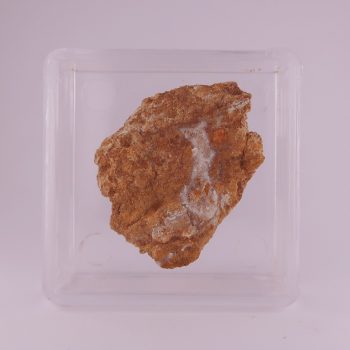
Information about Minyulite
Minyulite is a rare potassium aluminium fluorophosphate mineral, best known among collectors for its neat white to colourless radiating sprays of needle-like crystals, which form small but attractive pincushion-like tufts on their host rock.
It is one of a group of secondary phosphate minerals found in phosphate-rich sedimentary deposits and, unusually, in soils created by the prolonged accumulation of seabird droppings.
It typically occurs as slender, square-sectioned acicular to prismatic crystals in divergent radiating sprays and pincushion-like aggregates, occasionally reaching 1 cm or more across at the best localities. It is typically white to colourless, occasionally very pale greenish-yellow, with a vitreous to silky lustre. Individual crystals are transparent to translucent. The square cross-section of individual crystals is a characteristic feature visible under magnification.
Minyulite forms as a secondary phosphate mineral – that is, through the breakdown and recrystallisation of earlier phosphate minerals – in two quite different but related settings. The more geologically conventional setting is in phosphatic ironstone and sedimentary phosphate deposits, where it forms in rock cavities alongside wavellite, fluellite, variscite, and apatite.
The more unusual setting is in ornithogenic soil – soil formed beneath long-established seabird colonies, where the prolonged accumulation and chemical breakdown of guano creates a localised phosphate-rich environment in which minyulite and related phosphates can crystallise. It is one of a relatively small number of minerals known to form in this way.
Its formula was formally redefined by the IMA in 2021, clarifying the fluorine content as the dominant anion in the structure.
Uses and History
Minyulite has no industrial or gemological applications. It is collected as a mineral specimen, valued for the delicacy of its crystal sprays and the neatness of its pincushion aggregates.
The mineral was first described in 1933 by E.S. Simpson and C.R. Le Mesurier, from specimens collected at Minyulo Well near Dandaragan in Western Australia – its type locality – where it was found in weathered glauconitic phosphatic ironstone. The name is taken directly from the type locality.
A subsequent description in 1943 by Spencer, Bannister, Hey, and Bennett formally established the mineral from material collected at Tom’s Quarry in Kapunda, South Australia, which remains one of the finest known sources of collectable specimens.
Notable localities for collectable material include Tom’s Quarry at Kapunda in South Australia, where white pincushion aggregates to 1 cm or more are associated with aldermanite and fluellite on a pale matrix; the Penrice Quarry and Moculta Phosphate Quarry at Angaston in the Barossa Valley, South Australia; St John’s Quarry at Kapunda, also South Australia; the original type locality at Minyulo Well near Dandaragan in Western Australia; the La Floquerie Quarry at Pannecé in Loire-Atlantique, France, one of the better European sources; the Pereta Mine at Scansano in Tuscany, Italy; the Cerro Mejillones locality on the Mejillones Peninsula in the Antofagasta Region of Chile; the Ross Hannibal and Wharf mines in the Black Hills of South Dakota, USA; Échassières in the Allier département of France; and localities in Belgium.
Mineralogy
Hazards and Warnings
No specific health risks have been formally recorded for minyulite. Mineral collectors should wash their hands after handling specimens as a matter of good practice.
Almost all rocks, minerals (and, frankly, almost all other substances on earth) can produce toxic dust when cutting, which can cause serious respiratory conditions including silicosis. When cutting or polishing rocks, minerals, shells, etc, all work should be done wet to minimise the dust, and a suitable respirator or extraction system should be used.
Translations
Arabic:
Hindi:
Portuguese:
- Minyulita
Bengali:
Indonesian:
Punjabi:
English:
- Minyulite
Italian:
- Minyulite
Russian:
- Миньюлит
French:
- Minyulite
Japanese:
Spanish:
- Minyulita
German:
- Minyulit
Korean:
Thai:
Gujurati:
Mandarin Chinese:
Urdu: