
Decrespignyite
Decrespignyite-(Y) is a copper yttrium rare earth mineral.
Found only at this single locale, the mineral is thought to be formed as carbonated groundwater precipitates through an ore body.
Showing the single result
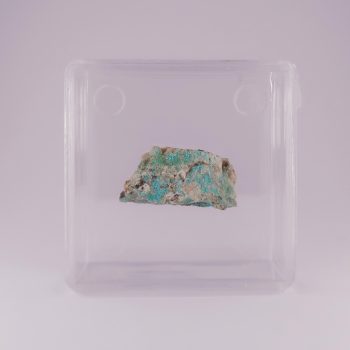
Information about Decrespignyite-(Y)
Decrespignyite-(Y) is one of the rarest minerals in the world, with a single confirmed locality: the Paratoo copper mine near Yunta in the Olary district of South Australia.
It is a complex copper yttrium rare-earth carbonate chloride hydrate, forming microscopic royal-blue to turquoise-blue pseudohexagonal platelets typically only 10–50 micrometres in size – crystals that are invisible to the naked eye and visible only under magnification.
Despite its extreme rarity and minute crystal size, decrespignyite-(Y) is of considerable scientific interest as a rare-earth carbonate mineral with a genuinely novel structural arrangement, and specimens from the type locality are among the most prized of all rare-earth mineral specimens in institutional and specialist collections.
The mineral occurs as royal-blue coatings, crusts, and cavity fillings on the slaty country rock at Paratoo, where it was deposited from mildly alkaline carbonated groundwaters percolating through the ore body.
It is associated with other unusual yttrium-rare-earth carbonates including kamphaugite-(Y), caysichite-(Y), donnayite-(Y) – now believed in the Paratoo context to be largely alicewilsonite-(YLa) – and with malachite. The assemblage as a whole represents an exceptionally unusual convergence of copper mineralisation and rare-earth geochemistry.
The suffix -(Y) in the name indicates that yttrium is the dominant rare-earth element in the octahedral sites of the crystal structure, following IMA (International Mineralogical Association) nomenclature conventions for minerals with variable dominant cations.
Uses and History
Decrespignyite-(Y) has no applications outside science and specialist mineral collecting. Specimens from the Paratoo type locality are the only source of the mineral known anywhere in the world.
The mineral was named in honour of Robert Champion de Crespigny (born 1950), a prominent figure in the Australian mining industry who held the positions of Executive Chairman of Normandy Mining, Chancellor of the University of Adelaide, and Chairman of the South Australian Museum at the time of the mineral’s description.
The crystal structure of decrespignyite-(Y) – extremely difficult to determine owing to the minute size of the crystals – was eventually solved in 2020 by Rius and co-workers using three-dimensional electron diffraction combined with synchrotron powder diffraction methods, published in the European Journal of Mineralogy.
Mineralogy
Hazards and Warnings
Contains copper: wash hands after handling. Rare-earth elements at collector-specimen concentrations present no known acute hazard under normal handling, but fine dust should not be inhaled as a general precaution.
Almost all rocks, minerals (and, frankly, almost all other substances on earth) can produce toxic dust when cutting, which can cause serious respiratory conditions including silicosis. When cutting or polishing rocks, minerals, shells, etc, all work should be done wet to minimise the dust, and a suitable respirator or extraction system should be used.
Translations
Arabic:
Hindi:
Portuguese:
Bengali:
Indonesian:
Punjabi:
English:
- Decrespignyite-(Y)
Italian:
Russian:
- Декреспиньиит-(Y)
French:
- Décrespignyite-(Y)
Japanese:
Spanish:
- Decrespignyita-(Y)
German:
- Decrespignit-(Y)
Korean:
Thai:
Gujurati:
Mandarin Chinese:
Urdu: