
Cyanotrichite
Cyanotrichite is a rare and exquisitely beautiful secondary copper aluminium sulphate hydroxide mineral, known for forming fine acicular crystals, of interest to micro-mineral collectors.
Showing all 2 results
-
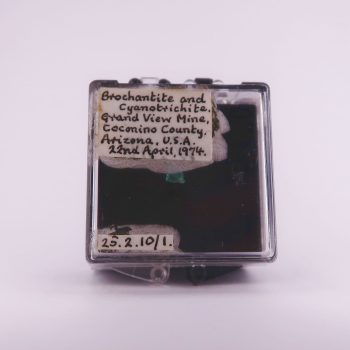
Brochantite and Cyanotrichite from Grand View Mine, USA
£10.00 -
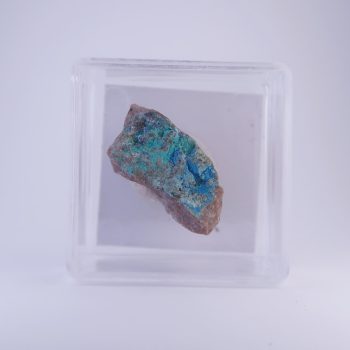

Carbonatecyanotrichite, Malachite, Cerussite and Linarite from Wedding Cave Mine, Wales
£20.00
Information about Cyanotrichite
Cyanotrichite is a rare and exquisitely beautiful secondary copper aluminium sulphate hydroxide mineral, forming silky sky-blue to azure-blue tufts of hair-fine acicular crystals that are among the most delicate and ethereal-looking objects in the mineral kingdom.
Its name means “blue hair” in Greek (kyanos, blue, + thrix/trichos, hair), an accurate description of the wispy, cobwebby or velvet-like aggregates of microscopically thin needles that drape across the surfaces of matrix minerals in thin, soft, silky mats. Even very small specimens, viewed in good light, have a distinctive luminous quality that makes cyanotrichite immediately recognisable.
It is a secondary mineral forming in the oxidised zones of copper-sulphide ore deposits where aluminium is available – typically from the breakdown of aluminous country rocks such as schists or from aluminium-bearing vein minerals.
It typically occurs on iron-oxide-rich gossan or limonite matrix, in association with other secondary copper minerals including brochantite, azurite, malachite, and antlerite. Individual needles are typically only a fraction of a millimetre in width, though they may reach several millimetres in length; under magnification the crystals are orthorhombic and bladed rather than truly hair-like.
A note for collectors: Cyanotrichite is fragile and should be handled and stored with the greatest care. The fine acicular crystals are easily damaged by touch, vibration, or rubbing against wrapping materials. Specimens should be stored in padded boxes or cotton wool with the crystals protected, and never wrapped in tissue paper that contacts the crystal surface directly.
Uses and History
Cyanotrichite has no industrial applications and is collected purely as a specimen mineral, prized above all for its distinctive sky-blue velvet-like habit.
The mineral was first described in 1839 from specimens collected in oxidised zones of copper deposits in the Banat region of Romania.
Fine specimens have come from a number of localities worldwide, including the famous Tsumeb mine in Namibia, which has produced some of the finest known examples; the Ojuela mine at Mapimí in Durango, Mexico; various copper deposits in Arizona, USA; the Minas de Cobre at Calañas in Huelva province, Spain; and numerous Romanian localities.
In Wales, cyanotrichite has been recorded from the Great Orme copper mine at Llandudno, Gwynedd, in the oxidised zone of the prehistoric copper workings. In Cornwall, occurrences are recorded from several mines in the copper mining districts. Material from both British localities is typically microscopic and of limited collecting quality compared to Tsumeb or Mapimí specimens.
Mineralogy
Hazards and Warnings
Toxic mineral: contains copper and sulphate. Copper compounds are toxic. Wash hands after handling, avoid inhaling dust, and keep away from children and food preparation areas.
Almost all rocks, minerals (and, frankly, almost all other substances on earth) can produce toxic dust when cutting, which can cause serious respiratory conditions including silicosis. When cutting or polishing rocks, minerals, shells, etc, all work should be done wet to minimise the dust, and a suitable respirator or extraction system should be used.
Translations
Arabic:
Hindi:
Portuguese:
- Cianotrichita
Bengali:
Indonesian:
Punjabi:
English:
- Cyanotrichite
Italian:
- Cianotrichite
Russian:
- Цианотрихит
French:
- Cyanotrichite
Japanese:
- シアノトリカイト
Spanish:
- Cianotrichita
German:
- Zyanotrichit
Korean:
Thai:
Gujurati:
Mandarin Chinese:
Urdu: