
Cumengeite
An uncommon secondary mineral, which can form some extremely unusual pieces – a combination between boleite and cumengeite can form an unusual ‘star’ like intergrowth.
Showing all 2 results
-
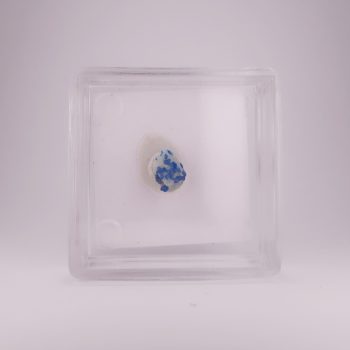
Cumengeite from Amelia Mine, Mexico
£35.00 -
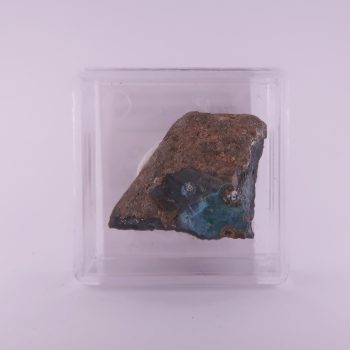

Cumengeite from Penpol smelter slag locality, Cornwall
Price range: £2.00 through £10.00
Information about Cumengeite
Cumengeite is one of the rarest and most visually extraordinary of all the lead-copper halide minerals, forming deep indigo-blue to violet-blue tetragonal crystals of geometric perfection that are among the most architecturally striking specimens in all of mineralogy.
It belongs to a small and unusual group of lead-copper oxychloride minerals found in the oxidised zones of certain arid-region polymetallic ore deposits, alongside related species such as boleite, pseudoboleite, and diaboleite – minerals that share a common deep blue colour and a similarly restricted occurrence in the Boleo district of Baja California Sur, Mexico, which remains the only locality in the world from which fine cumengeite specimens are known.
Cumengeite crystals are tetragonal bipyramids, sometimes truncated, with steeply pointed terminations. They are typically a few millimetres in size, but their near-perfect geometric form and saturated deep indigo-blue colour are immediately striking.
They commonly occur intergrown with boleite, forming composite crystals in which the boleite forms the pale blue cubic cores and cumengeite the darker blue bipyramidal overgrowths – one of the most remarkable epitaxial relationships in mineralogy, and a source of endless fascination to those who study these minerals under magnification.
A note for collectors: Boleite, pseudoboleite, and cumengeite from the Boleo district are among the most avidly collected and studied of the rarer mineral species. Their similar deep blue colours and shared locality mean that positive identification between them requires careful examination of crystal form and, for certainty, X-ray diffraction. Cumengeite is the least common of the three.
Uses and History
Cumengeite has no industrial applications. It is collected exclusively as a specimen mineral, and fine examples are rarely encountered and highly prized.
The mineral was first described from specimens collected at the Boleo copper mine near Santa Rosalía in Baja California Sur, Mexico and named in honour of Édouard Cumenge (1828–1902), a French mining engineer who worked extensively in Mexico and contributed significantly to the study of the Boleo deposit. The Boleo district, a stratabound copper deposit in Miocene sedimentary rocks influenced by evaporitic brines, has produced a unique assemblage of oxidised lead-copper halides found nowhere else in such quality.
The Boleo mine ceased active copper production in the 20th century, but fine specimens from historic Boleo collections continue to appear on the market. Outside Boleo, cumengeite is known from only a handful of localities worldwide, including Broken Hill in New South Wales, Australia, and a few interesting slag localities – including in Greece and the UK.
Mineralogy
Hazards and Warnings
Toxic mineral: contains lead and copper and chloride. Lead is a serious cumulative toxin. Wash hands thoroughly after handling, avoid inhaling dust, and keep away from children and food preparation areas.
Almost all rocks, minerals (and, frankly, almost all other substances on earth) can produce toxic dust when cutting, which can cause serious respiratory conditions including silicosis. When cutting or polishing rocks, minerals, shells, etc, all work should be done wet to minimise the dust, and a suitable respirator or extraction system should be used.
Translations
Arabic:
Hindi:
Portuguese:
- Cumengita
Bengali:
Indonesian:
Punjabi:
English:
- Cumengeite
Italian:
- Cumengite
Russian:
- Куменгеит
French:
- Cumengéite
Japanese:
Spanish:
- Cumengita
German:
- Cumengeit
Korean:
Thai:
Gujurati:
Mandarin Chinese:
Urdu: