
Cristobalite
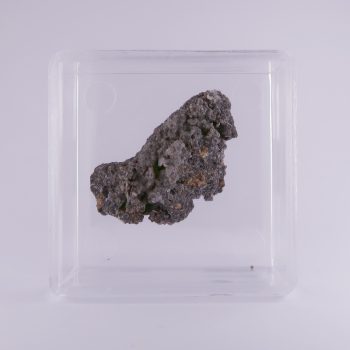
A high temperature polymorph of silica; cristobalite has the same chemical formula as Quartz – SiO2.
It is most commonly found as an inclusion in ‘Snowflake’ Obsidian, but can be found as crystals.
Showing the single result
Information about Cristobalite
Cristobalite is a high-temperature polymorph of silica (SiO2), stable at temperatures above approximately 1,470°C at atmospheric pressure, and one of seven recognised polymorphs of silica alongside quartz, tridymite, coesite, stishovite, moganite, and seifertite.
In nature it occurs most characteristically in the groundmass of silicic volcanic rocks – particularly in obsidian, rhyolite, and pumice – where rapid cooling has preserved the high-temperature form metastably at surface conditions. It also occurs in fumarolic encrustations, in some meteorites and lunar rocks, and as a product of the thermal alteration of opal.
Well-crystallised specimens of cristobalite are rare and of limited collecting interest in themselves, as crystals are typically very small and white to colourless. The mineral is more significant scientifically than aesthetically: it serves as a petrogenetic indicator of high-temperature volcanic environments, it has been identified in samples returned from the Moon and in meteoritic material, and it is of considerable industrial importance as a high-temperature refractory material and in the manufacture of silicon-based ceramics.
At around 220–270°C, cristobalite undergoes a displacive polymorphic transition between a low (α) form (tetragonal, stable below the transition) and a high (β) form (cubic, stable above). This transition involves a significant volume change and is relevant to refractory engineering.
Important health note: Crystalline silica in all its forms, including cristobalite, is a confirmed human respiratory carcinogen. Cristobalite is of particular occupational concern because it is produced by high-temperature processing of diatomaceous earth, and occurs naturally in volcanic ash and pumice. Inhalation of fine cristobalite dust over time causes silicosis. See hazards section below.
Uses and History
Cristobalite was first described from specimens in the trachytes of the San Cristóbal Hill (Cerro San Cristóbal) in Pachuca, Hidalgo, Mexico – its namesake locality.
Industrially, cristobalite and amorphous silica derived from volcanic sources are used in refractory materials, investment casting moulds, electronics (silicon chips require highly pure SiO2), and as a filler in paints, rubber, and plastics.
The conversion of diatomaceous earth (amorphous opaline silica) to cristobalite by heating is an important manufacturing step in some of these applications, and also the source of occupational exposure risk in the diatomite processing industry.
In a collecting context, cristobalite is occasionally found as white chalky spheres or small octahedral-looking crystals in obsidian (the white spots commonly called “snowflakes” in snowflake obsidian are often devitrification products consisting partly of cristobalite and partly of other silica polymorphs and feldspars). It also occurs as delicate white coatings on the inner walls of volcanic cavities.
Mineralogy
Hazards and Warnings
Confirmed respiratory carcinogen: crystalline silica dust causes silicosis and lung cancer. Cristobalite is classified as a Group 1 human carcinogen by the International Agency for Research on Cancer (IARC) when inhaled as fine particulate from occupational sources. Fine cristobalite dust is significantly more harmful than quartz dust of equivalent size. This hazard applies specifically to fine respirable dust generated by cutting, grinding, or processing; normal handling of intact specimens presents no acute risk.
When cutting, grinding, or working with cristobalite-bearing rocks (including obsidian, pumice, or volcanic ash), all work should be done wet, and a properly rated respirator (P3 or equivalent) must be worn. Do not dry-cut, dry-grind, or sand-blast siliceous volcanic rocks.
Translations
Arabic:
Hindi:
Portuguese:
- Cristobalite
Bengali:
Indonesian:
Punjabi:
English:
- Cristobalite
Italian:
- Cristobalite
Russian:
- Кристобалит
French:
- Cristobalite
Japanese:
- クリストバル石
Spanish:
- Cristobalita
German:
- Cristobalit
Korean:
Thai:
Gujurati:
Mandarin Chinese:
- 方石英
Urdu: