
Cornwallite
An uncommon copper arsenate mineral well known by Cornish mineral collectors.
Particularly popular amongst micro mineral collectors for well formed crystals.
Toxic mineral: contains arsenic.
Showing all 2 results
-

Cornwallite and Olivenite from Dorothea Mine, Germany
£10.00 -
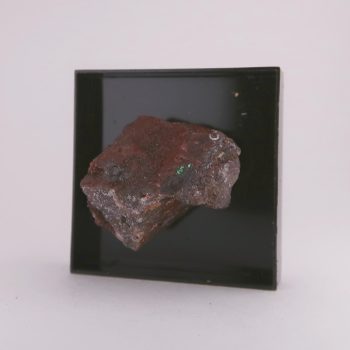

Cornwallite from Sir Dominick Mine, Australia
£10.00
Information about Cornwallite
Cornwallite is an uncommon secondary copper arsenate mineral closely related to olivenite, clinoclase, and cornubite, and is the monoclinic dimorph of the triclinic mineral cornubite – the two sharing identical chemistry but different crystal structures.
It forms in the oxidised zones of copper-arsenic ore deposits as bright emerald-green to dark green globular, botryoidal, or fibrous-radiated masses and crusts, and is valued by collectors both for its vivid colour and its strong connection to Cornwall, from which it takes its name.
Its closest visual confusion is with malachite, which can produce very similar green botryoidal coatings and crusts. The key practical distinction is that cornwallite does not effervesce with acid (it is an arsenate, not a carbonate), while malachite reacts immediately and vigorously – a simple and definitive field test. Cornwallite also tends to form more compact, finely fibrous masses rather than the banded concentric structure often seen in malachite.
It belongs to the same close family of basic copper arsenates as clinoclase, cornubite, and olivenite, and these minerals often occur together in the same oxidised gossan zones. Raman spectroscopy is required to distinguish cornwallite reliably from cornubite, as both share the same green colour and botryoidal habit.
A note for collectors: Cornwallite, cornubite, and clinoclase are easily confused with each other and with malachite in the field. The acid test reliably separates the arsenates from carbonates, but distinguishing between the arsenate dimorphs cornwallite and cornubite requires X-ray diffraction or Raman spectroscopy.
Uses and History
Cornwallite has no industrial applications. It is collected as a specimen mineral, valued for its vivid emerald-green colour and its Cornish provenance.
The mineral was first described in 1846 from specimens collected at the Wheal Gorland mine at St Day in the St Day United Mines district of Cornwall – its type locality and namesake. Wheal Gorland has yielded type specimens for an extraordinary number of secondary copper and arsenic minerals, including clinoclase, chalcophyllite, ceruleite, cornwallite, and several others, making it one of the most mineralogically productive single localities in British mineral history. Most Wheal Gorland material is now in museum collections or long-dispersed private collections, as the mine has been closed for well over a century.
Fine specimens have since been found at other localities worldwide, including Cap Garonne in the Var department of southern France, which has produced some excellent modern material; Majuba Hill in Nevada, USA; various German, Slovakian, and Moroccan localities; and porphyry copper districts in Arizona.
There are other UK localities – Penberthy Croft Mine especially should be viewed as a good source of cornwallite.
Mineralogy
Hazards and Warnings
Toxic mineral: contains copper and arsenic. Both elements are significant health hazards. Wash hands thoroughly after handling, avoid inhaling dust, and keep away from children and food preparation areas. Do not lick or place in the mouth.
Almost all rocks, minerals (and, frankly, almost all other substances on earth) can produce toxic dust when cutting, which can cause serious respiratory conditions including silicosis. When cutting or polishing rocks, minerals, shells, etc, all work should be done wet to minimise the dust, and a suitable respirator or extraction system should be used.
Translations
Arabic:
Hindi:
Portuguese:
- Cornwallita
Bengali:
Indonesian:
Punjabi:
English:
- Cornwallite
Italian:
- Cornwallite
Russian:
- Корнваллит
French:
- Cornwallite
Japanese:
- コーンウォール石
Spanish:
- Cornwallita
German:
- Cornwallit
Korean:
Thai:
Gujurati:
Mandarin Chinese:
Urdu: