
Copiapite
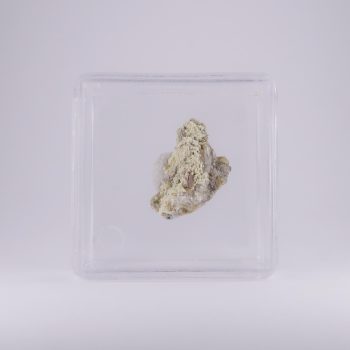
Copiapite is a hydrated iron sulphate mineral, formed due to the weathering of iron sulphide minerals.
It forms sulphur yellow to orange crystals, or a yellow-green massive material.
Showing the single result
Information about Copiapite
Copiapite is a striking secondary iron sulphate mineral, most immediately recognisable by its vivid sulphur-yellow to golden-yellow colour and its bright powdery or scaly crystalline coatings.
It belongs to the copiapite group, a family of hydrated mixed-valence iron sulphates with the general formula Fe2+Fe3+4(SO4)6(OH)2·20H2O, in which partial substitution of iron by magnesium, aluminium, copper, or zinc produces a series of related species. Pure copiapite is the iron end-member of this group.
It forms in the highly acidic environments produced by the oxidation of iron sulphide minerals, particularly pyrite, in conditions of periodic wetting and drying.
It is therefore a mineral of mine dumps, tailings, arid desert sulphide outcrops, and fumarolic volcanic environments. Its bright colour and the chalky to scaly texture of its crystalline masses make it easy to spot in the field, though it is water-soluble and quickly dissolves in rain – a characteristic it shares with other efflorescent sulphate minerals such as melanterite, melanterite, and rozenite.
The copiapite group minerals are of significant environmental importance as they represent a major acid-generating mechanism in the oxidation of sulphide mine waste. Their dissolution releases sulphuric acid and soluble iron into drainage waters, contributing to acid mine drainage – one of the most widespread environmental impacts of metal mining worldwide.
A note for collectors: As a water-soluble mineral, copiapite specimens must be stored sealed and away from humidity. Even moderate atmospheric moisture can cause surface dissolution and re-crystallisation that alters the appearance of specimens. Museum-quality copiapite typically comes from dry desert localities such as the Atacama where aridity preserves these otherwise ephemeral minerals.
Uses and History
Copiapite has no significant industrial uses in its own right, though the iron sulphate group minerals as a whole are relevant to understanding acid mine drainage chemistry and to hydrometallurgical ore processing.
The mineral was first described from specimens collected in the Atacama Desert province of Copiapó in northern Chile – the locality from which its name is derived. The Atacama Desert, one of the driest places on Earth, provides exactly the extreme aridity needed to preserve water-soluble sulphate minerals that would dissolve rapidly in more humid climates, and remains the principal source of fine copiapite specimens to this day.
Notable localities include the Alcaparrosa Mine and other workings in the Copiapó district of Atacama, Chile, which have produced exceptionally pure sulphur-yellow crystalline masses and coatings; the Santa Elena Mine at Guanaco and the Emma Luisa Mine at Taltal, also in northern Chile; and several arid oxidised pyritic localities in Spain and Germany.
In Britain, copiapite has been recorded from a handful of mine waste and drainage localities, particularly from pyrite-bearing metalliferous mine tips in Cornwall and Wales, but specimens are typically poor and ephemeral compared to Chilean material.
Mineralogy
Hazards and Warnings
Keep specimens dry: water-soluble mineral. Store in sealed containers away from humidity; do not store with minerals that require water or humidity. Copiapite and related iron sulphates dissolve readily in water and will be destroyed by rain or moist conditions.
Iron sulphate minerals should be handled with care. Wash hands after handling. The highly acidic nature of copiapite and associated acid mine drainage minerals makes inhalation of fine dust undesirable.
Almost all rocks, minerals (and, frankly, almost all other substances on earth) can produce toxic dust when cutting, which can cause serious respiratory conditions including silicosis. When cutting or polishing rocks, minerals, shells, etc, all work should be done wet to minimise the dust, and a suitable respirator or extraction system should be used.
Translations
Arabic:
Hindi:
Portuguese:
- Copapita
Bengali:
Indonesian:
Punjabi:
English:
- Copiapite
Italian:
- Copapite
Russian:
- Копиапит
French:
- Copiapite
Japanese:
Spanish:
- Copapita
German:
- Kopiapit
Korean:
Thai:
Gujurati:
Mandarin Chinese:
- 叶绿矾
Urdu: