
Clinoclase
An uncommon copper arsenate mineral, which forms as a secondary mineral in weathered copper sulphide deposits.
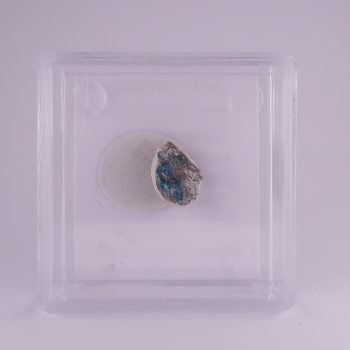
Can form excellent dark blue crystals.
Toxic mineral: contains arsenic.
Showing the single result
Information about Clinoclase
Clinoclase is a rare and visually striking secondary copper arsenate mineral, valued by collectors for its intense deep blue-green to blue-black colour, its fine needle-like radiating crystals, and its strong association with the historic mining districts of Cornwall, where it has been found in some of its finest forms.
It is a close chemical and mineralogical relative of olivenite, cornwallite, and cornubite – a family of secondary copper arsenates that characterise the oxidised zones of copper-arsenic ore deposits.
It typically forms as acicular or prismatic crystals arranged in radiating fans, spherical aggregates, or rosette-like clusters, sometimes with individual crystals taking on a pseudohexagonal outline. The colour ranges from deep azure-blue to emerald-green or near-black, and the lustre is vitreous to subadamantine. On cleavage surfaces it becomes pearly.
The combination of dark intense colour, subadamantine lustre, and radial fan habit makes it immediately recognisable among the secondary copper minerals, though its close relatives require X-ray diffraction to distinguish reliably.
Its name derives from the Greek klino (inclined) and klasis (breaking), a direct reference to its perfect cleavage on {001} and the oblique angle at which this cleavage meets the crystal faces – a defining structural characteristic. The alternative historic name abichite is rarely used today.
A note for collectors: Clinoclase, cornwallite, cornubite, and olivenite form a closely related group of basic copper arsenates that can be extremely difficult to distinguish by eye. Clinoclase is characterised by its acicular radiating habit and deep blue-black to dark green colour, but visual identification alone is not reliable, and X-ray diffraction is the only definitive method. Old collection material should be treated as provisional identification unless analytically confirmed.
Uses and History
Clinoclase has no industrial or gemological uses. It is collected as a mineral specimen, prized for its colour and habit and its historic Cornish provenance.
The mineral was first described from specimens collected at the Wheal Gorland mine at St Day in Cornwall – a locality that remains one of the world’s finest sources of clinoclase and a landmark site for secondary copper arsenate minerals more broadly.
Wheal Gorland has yielded type specimens of clinoclase, chalcophyllite, ceruleite, cornwallite, and several other secondary arsenates, and its old collections, preserved in museums and private hands, remain irreplaceable. The Williams Collection housed at Caerhays Castle in Cornwall contains some of the most celebrated clinoclase specimens known.
The mineral has since been found at numerous worldwide localities, including Broken Hill in New South Wales, Australia; porphyry copper deposits in Arizona, Utah, Nevada, and Montana in the United States; the Majuba Hill mine in Pershing County, Nevada; various German, Czech, and French localities; and Cap Garonne in the Var department of southern France.
Mineralogy
Hazards and Warnings
Toxic mineral: contains copper and arsenic. Both elements are significant health hazards. Wash hands thoroughly after handling, avoid inhaling dust, and keep away from children and food preparation areas. Do not lick or place in the mouth.
Almost all rocks, minerals (and, frankly, almost all other substances on earth) can produce toxic dust when cutting, which can cause serious respiratory conditions including silicosis. When cutting or polishing rocks, minerals, shells, etc, all work should be done wet to minimise the dust, and a suitable respirator or extraction system should be used.
Translations
Arabic:
Hindi:
Portuguese:
- Clinoclase
Bengali:
Indonesian:
Punjabi:
English:
- Clinoclase
Italian:
- Clinoclasio
Russian:
- Клинокласт
French:
- Clinoclase
Japanese:
- クリノクレース
Spanish:
- Clinoclasa
German:
- Klinoklas
Korean:
Thai:
Gujurati:
Mandarin Chinese:
Urdu: