
Chenevixite
A secondary copper-iron arsenate mineral, typically found around other arsenate and carbonate copper minerals.
Mostly of interest to micromount specimen collectors.
Toxic mineral: contains arsenic.
Showing the single result
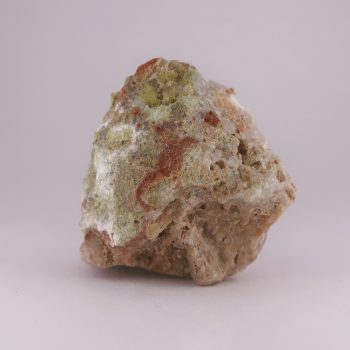
Information about Chenevixite
Chenevixite is a secondary copper iron arsenate hydroxide mineral forming in the oxidised zones of polymetallic ore deposits.
Its naming history is remarkable for its irony: the mineral was named after Richard Chenevix, an Irish-born chemist who explicitly and publicly objected to the practice of naming minerals after people – a position he set out in his 1811 work Observations on Mineralogical Systems – yet a mineral was named for him anyway, presumably because the analytical work he published in 1801 on a Cornish arsenate of copper and iron had been the first scientific description of what was later recognised as the mineral bearing his name.
Chenevixite typically forms as olive-green to dark green to yellowish-green compact masses, crusts, and botryoidal aggregates, rarely as tiny prismatic crystals visible under magnification.
It is the Fe3+-dominant member of the chenevixite-luetheite series, in which aluminium substitutes for iron to produce luetheite. It belongs to the same secondary arsenate family as olivenite, cornwallite, and strashimirite – all sharing the copper-arsenic-hydroxide chemistry and the oxidised zone origin – and is a relatively inconspicuous member of that family without the striking colours of olivenite or the unusual habits of strashimirite.
Uses and History
Chenevixite has no industrial applications. It is collected as a scientific specimen.
Richard Chenevix (c. 1774, Ballycommon, Co. Offaly, Ireland – 5 April 1830, Paris) was a chemist and playwright who worked primarily in France and England. In 1801 he published in the Philosophical Transactions of the Royal Society a detailed analysis of arsenates of copper and iron from Cornwall, which later proved to describe chenevixite.
His 1811 Observations on Mineralogical Systems opposed the naming of minerals after people, arguing that descriptive or chemical names were more useful. The mineral was formally described and named chenevixite by F. Pisani in 1866, from Cornish material, apparently in deliberate commemoration of the very man who had argued against such commemorations. No record survives of whether Pisani intended this as a tribute, an irony, or simply a straightforward acknowledgement of Chenevix’s foundational analytical work.
The finest collector specimens come from the Clara Mine at Oberwolfach in Baden-Württemberg, Germany, which produces the most photographed material; the Christiana and related mines at Laurion (Lavrion), Attica, Greece; and from Cornwall, England, including the type material region. The mineral also occurs at Arizona porphyry copper deposits, as documented in the crystal structure paper by Burns, Smith, and Steele (2000) in Mineralogical Magazine.
Mineralogy
Hazards and Warnings
Highly toxic mineral: contains copper and arsenic. Arsenic compounds are highly toxic. Mineral collectors must wash their hands thoroughly after handling specimens, must not inhale any dust, and must keep specimens away from children.
Almost all rocks, minerals (and, frankly, almost all other substances on earth) can produce toxic dust when cutting, which can cause serious respiratory conditions including silicosis. When cutting or polishing rocks, minerals, shells, etc, all work should be done wet to minimise the dust, and a suitable respirator or extraction system should be used.
Translations
Arabic:
Hindi:
Portuguese:
- Chenevixita
Bengali:
Indonesian:
Punjabi:
English:
- Chenevixite
Italian:
- Chenevixite
Russian:
French:
- Chénevixite
Japanese:
Spanish:
- Chenevixita
German:
- Chenevixít
Korean:
Thai:
Gujurati:
Mandarin Chinese:
Urdu: