
Chalcophyllite
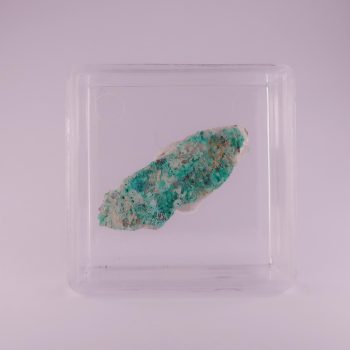
A rare copper-aluminium arsenate mineral which occurs in the oxidised zones of some arsenic bearing copper deposits.
Can form some exceptional crystals for micro mineral collectors.
Toxic mineral: contains arsenic.
Showing the single result
Information about Chalcophyllite
Chalcophyllite is a secondary copper aluminium arsenate sulphate mineral, and one of the most visually distinctive of the secondary copper arsenate group – its large, flat, hexagonal tabular crystals with a vivid emerald-green to blue-green colour and perfect micaceous basal cleavage give it an almost gem-like quality when well-crystallised, and the finest specimens from Cornwall are among the most photographed of all British mineral specimens.
The name is from the Greek khalkos (copper) and phyllon (leaf), describing the perfectly flat, leaf-like habit of its crystals.
It forms tabular to platy crystals with a strongly developed hexagonal to pseudo-hexagonal outline and perfect basal cleavage, producing thin, shiny, flat plates that flex slightly before cleaving – a habit shared with the micas and which makes chalcophyllite immediately recognisable.
The colour ranges from bright emerald-green through blue-green to bluish. Crystals may be transparent to translucent, with a vitreous to pearly lustre on cleavage surfaces. It may be partially dehydrated on exposure to dry air, causing slight changes in colour and transparency.
Chalcophyllite forms in the oxidised zone of copper-arsenic bearing polymetallic deposits, typically at somewhat deeper oxidation levels than many other secondary copper minerals. It is not uncommon at Cornish localities, where the arsenic-rich copper mineralogy of the granitic tin-copper veins provides ideal conditions for arsenate formation.
Uses and History
Chalcophyllite has no industrial applications. Fine Cornish specimens were among the most important secondary minerals in the collections of nineteenth-century British mineralogists, and the mineral appears in Augustus Henry Church’s important 1870 paper on Cornish minerals published in the Journal of the Chemical Society.
The finest collector specimens come from the Wheal Gorland locality at St Day in Cornwall, England – the classic and most celebrated source for British secondary arsenate minerals – where chalcophyllite forms large, exceptionally well-formed emerald-green tabular crystals.
The Salsigne Mine in Aude, Occitanie, France is the primary source of modern market specimens, producing vivid blue-green material on white quartz. The Majuba Hill Mine in Pershing County, Nevada, USA is another well-documented source.
Mineralogy
Spangolite (also tabular, blue-green, hexagonal from Cornwall) is the main visual confusion; chalcophyllite is generally greener, spangolite more blue. Definitive distinction requires X-ray diffraction.
Hazards and Warnings
Highly toxic mineral: contains copper and arsenic. Arsenic compounds are highly toxic. Mineral collectors must wash their hands thoroughly after handling specimens, must not inhale any dust, and must keep specimens away from children. Note also that chalcophyllite specimens may dehydrate in dry storage conditions.
Almost all rocks, minerals (and, frankly, almost all other substances on earth) can produce toxic dust when cutting, which can cause serious respiratory conditions including silicosis. When cutting or polishing rocks, minerals, shells, etc, all work should be done wet to minimise the dust, and a suitable respirator or extraction system should be used.
Translations
Arabic:
Hindi:
Portuguese:
- Calcofílita
Bengali:
Indonesian:
Punjabi:
English:
- Chalcophyllite
- Tamarite (discredited synonym)
- Copper mica (informal)
Italian:
- Calcofillite
Russian:
- Халькофиллит
French:
- Chalcophyllite
Japanese:
Spanish:
- Calcofílita
German:
- Kupferglimmer / Chalcophyllit
Korean:
Thai:
Gujurati:
Mandarin Chinese:
- 葉銅礦
Urdu: