
Ceruleite
Ceruleite is an uncommon secondary copper-aluminium arsenate mineral which is known amongst micro-mineral collectors for fine sky-blue crystals.
Showing all 2 results
-
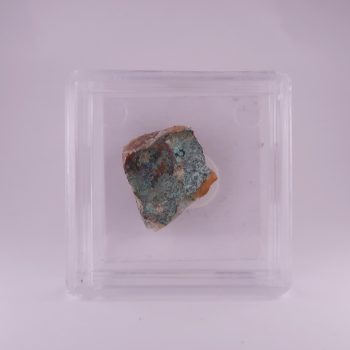
Ceruleite from Wheal Gorland, Cornwall
Price range: £20.00 through £25.00 -
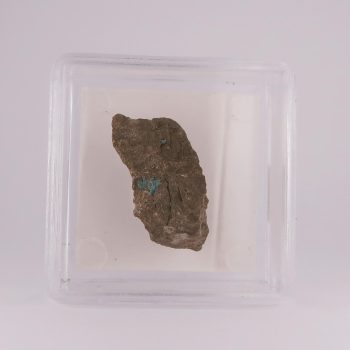

Ceruleite from Wheal Maid, Cornwall
£15.00
Information about Ceruleite
Ceruleite is a rare copper aluminium arsenate mineral, and one that earns collector attention primarily through its colour: a rich, opaque sky-blue to turquoise-blue so close to high-quality turquoise that the mineral has historically been used as a turquoise imitation and was initially described and collected partly in that context. Like turquoise, it typically forms as compact nodular masses and concretions rather than visible crystals, and like turquoise it has a porosity that makes large, clean, cuttable pieces rare and valuable.
It forms as compact masses, concretions, and nodules of opaque sky-blue to cerulean blue, occasionally with greenish-blue tones, with a waxy to earthy lustre and hardness of approximately 5-6, making it technically cuttable as a cabochon though the porosity means many pieces are impractical. Individual crystals, when visible at all, are tiny acicular rods arranged randomly within the compact mass. Above about 290°C the material turns green and becomes amorphous, so specimens should not be subjected to any heat treatment.
Ceruleite forms as a secondary mineral in the oxidised zones of copper-arsenic bearing hydrothermal deposits – the same geochemical setting as olivenite, cornwallite, and strashimirite – and is named from the Latin caeruleus (sky-blue), the most direct and honest naming in this batch.
Uses and History
Ceruleite has been historically used as a turquoise imitation, and compact nodular material of good colour has occasionally been cut into cabochons for jewellery. It has no industrial applications.
The finest collector specimens come from the Emma Luisa Mine at the Guanaco Mine locality in Taltal, Antofagasta Province, Chile – the type locality and primary source of specimen-quality ceruleite – and from Wheal Gorland, St Day, Cornwall, England.
Additional localities include several other copper-arsenic deposits in Chile, Bolivia, France (Cap Garonne in Var), Australia, and Namibia.
Mineralogy
Hazards and Warnings
Highly toxic mineral: contains copper and arsenic. Arsenic compounds are highly toxic. Mineral collectors must wash their hands thoroughly after handling specimens, must not inhale any dust, and must keep specimens away from children.
Almost all rocks, minerals (and, frankly, almost all other substances on earth) can produce toxic dust when cutting, which can cause serious respiratory conditions including silicosis. When cutting or polishing rocks, minerals, shells, etc, all work should be done wet to minimise the dust, and a suitable respirator or extraction system should be used.
Translations
Arabic:
Hindi:
Portuguese:
- Ceruleita
Bengali:
Indonesian:
Punjabi:
English:
- Ceruleite
Italian:
- Ceruleite
Russian:
- Церулеит
French:
- Céruléite
Japanese:
Spanish:
- Ceruleita
German:
- Ceruleít
Korean:
Thai:
Gujurati:
Mandarin Chinese:
Urdu: