
Celsian
An uncommon feldspar mineral probably best known for producing colourless-white prismatic and acicular crystals, popular amongst micromineral collectors.
Showing the single result
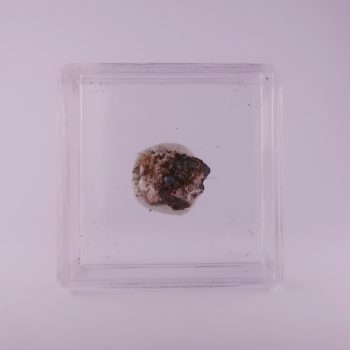
Information about Celsian
Celsian is the barium-dominant member of the feldspar group – the barium feldspar, in which barium substitutes for the potassium of orthoclase and sanidine in the feldspar framework structure, producing a mineral denser and slightly harder than the potassium feldspars, colourless to white, and relatively rare even in the manganese-rich metamorphic and metasomatic environments that are its primary geological setting.
It is both a scientific curiosity – barium feldspar is structurally distinct from both potassium and sodium feldspars in subtle ways – and an occasionally beautiful mineral, with fine transparent glassy crystals from certain localities.
It forms prismatic crystals, often with twinning, typically colourless to white or pale yellowish, with a vitreous lustre and transparent to translucent quality. It occurs primarily in manganese ore deposits that have been metamorphosed, where the unusual geochemistry concentrates barium alongside manganese, and in certain skarns and metasomatic environments. The mineral is typically associated with other barium minerals including barite, witherite, and the barium silicates – itself a geochemically unusual assemblage.
The partial solid solution between celsian (BaAl2Si2O8) and orthoclase (KAlSi3O8) is limited; intermediate compositions called hyalophane contain both Ba and K in their feldspar structure and occur more commonly than pure celsian in most geological settings.
Uses and History
Celsian has no significant industrial applications. Synthetic BaAl2Si2O8 is used in glass-ceramic composites for high-temperature structural applications. The mineral is collected as a scientific specimen.
The mineral was first described in 1895 by the Swedish mineralogist Stens Anders Hjalmar Sjögren, from specimens at the Jakobsberg mine in Värmland, Sweden, and named in honour of Anders Celsius (27 November 1701 – 25 April 1744), the Swedish astronomer and physicist who proposed and defined the Celsius temperature scale, was Professor of Astronomy at Uppsala University, and participated in a Lapland expedition that confirmed Newton’s prediction that the Earth is flattened at the poles.
The finest and most collector-relevant specimens come from Jakobsberg in Värmland, Sweden (the type locality); Benallt Mine on the Lleyn Peninsula (Llŷn) in Gwynedd, North Wales; and the Franklin and Sterling Hill mines in Sussex County, New Jersey, USA.
The Welsh occurrence is significant: celsian is confirmed by the Museum of Wales from Benallt Mine on the Llŷn Peninsula, where it occurs in barium-rich manganese ore deposits in Ordovician rocks. This makes celsian one of the mineral species with a confirmed Welsh locality of genuine international scientific interest.
Mineralogy
Hazards and Warnings
Contains barium. Barium compounds are toxic. Wash hands after handling. No acute hazard under normal specimen handling conditions for this insoluble barium silicate, but barium dust should not be inhaled.
Almost all rocks, minerals (and, frankly, almost all other substances on earth) can produce toxic dust when cutting, which can cause serious respiratory conditions including silicosis. When cutting or polishing rocks, minerals, shells, etc, all work should be done wet to minimise the dust, and a suitable respirator or extraction system should be used.
Translations
Arabic:
Hindi:
Portuguese:
- Celsiana
Bengali:
Indonesian:
Punjabi:
English:
- Celsian
- Barium feldspar
Italian:
- Celsiana
Russian:
- Целзиан
French:
- Celsiane
Japanese:
Spanish:
- Celsiana
German:
- Celsian
Korean:
Thai:
Gujurati:
Mandarin Chinese:
- 钡长石
Urdu: