
Brenkite
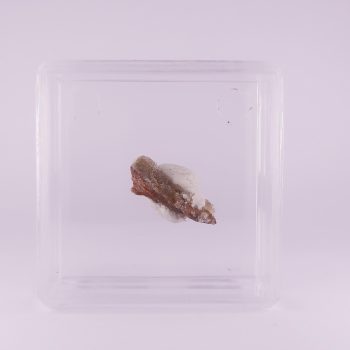
Brenkite is a very uncommon mineral, found only at a quarry known as Schellkopf, near Brenk, Germany, and named after the town.
It occurs in association with a range of zeolite minerals.
Showing the single result
Information about Brenkite
Brenkite is a very rare calcium fluoride carbonate mineral – one of only a small number of minerals containing both fluoride and carbonate together in the same structure – and is essentially confined to a single locality in the Eifel volcanic district of Germany.
It is the Eifel district’s contribution to the remarkably small class of fluoride carbonates, a group of minerals that exist because the Eifel’s calcium-rich xenoliths create precisely the unusual geochemical environment in which both carbonate and fluoride become simultaneously available for crystallisation at moderate temperatures.
It forms small, colourless to white prismatic crystals, typically in radial groups to about 4 mm, with a vitreous lustre and transparent to translucent quality. As a carbonate-fluoride, it is compositionally straightforward – the formula Ca2(CO3)F2 is essentially calcium carbonate modified by fluoride – but structurally it is distinct from both fluorite (CaF2) and calcite (CaCO3), forming its own orthorhombic structure.
It was described in 1978 from the Schellkopf quarry at Brenk in Rhineland-Palatinate – the same phonolite quarry that has given the district so many of its characteristic rare minerals – and named for that locality.
Uses and History
Brenkite has no industrial or gemological applications. It is collected as a scientific specimen and as part of the Eifel volcanic district suite.
The mineral was first described in 1978 by G. Hentschel, U. Leufer, and E. Tillmanns, in a paper published in Neues Jahrbuch für Mineralogie Monatshefte, titled “Brenkit, ein neues Kalzium-Fluor-Karbonat vom Schellkopf/Eifel” (Brenkite, a new calcium fluoride carbonate from the Schellkopf/Eifel). It was named after the village of Brenk in Rhineland-Palatinate, near which the Schellkopf phonolite quarry is located.
The primary locality is the Schellkopf quarry at Brenk, Brohltal, Ahrweiler district, Rhineland-Palatinate, Germany – the same Eifel locality that hosts zeophyllite, willhendersonite, vandermeerscheite, and schullerite found elsewhere on this site. Mindat records only three confirmed localities worldwide.
Mineralogy
Hazards and Warnings
Fluoride mineral. Contains fluoride; dust should not be inhaled. Wash hands after handling.
Almost all rocks, minerals (and, frankly, almost all other substances on earth) can produce toxic dust when cutting, which can cause serious respiratory conditions including silicosis. When cutting or polishing rocks, minerals, shells, etc, all work should be done wet to minimise the dust, and a suitable respirator or extraction system should be used.
Translations
Arabic:
Hindi:
Portuguese:
- Brenkita
Bengali:
Indonesian:
Punjabi:
English:
- Brenkite
Italian:
- Brenkite
Russian:
- Бренкит
French:
- Brenkite
Japanese:
Spanish:
- Brenkita
German:
- Brenkit
Korean:
Thai:
Gujurati:
Mandarin Chinese:
Urdu: