
Botryogen
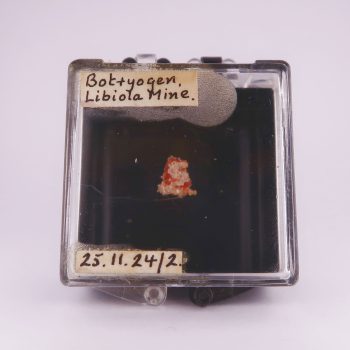
Botryogen is a hydrated iron sulphate mineral recognised for its red to orange tones, more often encountered as friable crusts or botryoidal coatings than as large crystals.
Its vivid colour and evaporite origin give it strong display appeal despite its fragility.
Showing the single result
Information about Botryogen
Botryogen is a rare hydrated magnesium iron sulphate mineral whose name – from the Greek βότρυς (bunch of grapes) and γεννάν (to bear, produce) – describes both the specimen habit that first distinguished it and the original description specimens that inspired the name when the mineral was described from the Falun copper mine in Sweden in 1828.
It is a secondary mineral forming in the oxidised zones of pyrite-bearing deposits, particularly in arid or semi-arid climates where the restricted water availability slows the further decomposition of the soluble sulphates to goethite or limonite.
It belongs to a classic chemical procession of iron sulphate minerals – alongside copiapite, jarosite, amarantite, melanterite, and fibroferrite – that form sequentially as conditions of pH, temperature, and oxidation-reduction potential shift in the near-surface environment.
Botryogen is specifically a mixed magnesium-iron sulphate, requiring both Mg and Fe3+ simultaneously in solution, which is why it is less common than the purely iron sulphates.
It forms monoclinic prismatic crystals, typically in radiating aggregates and botryoidal to reniform masses, bright orange-yellow to deep orange-red in colour, with a vitreous to resinous lustre and moderate transparency in individual crystals. The colour is characteristically vivid for a sulphate mineral and makes it immediately recognisable in hand specimen.
Uses and History
Botryogen has no industrial applications. It is collected as a mineral specimen.
The mineral was first described in 1828 by Wilhelm Haidinger from specimens at the Falun copper mine in Dalarna, Sweden, where it had been observed since at least 1815 when Jöns Jacob Berzelius described the same material as Rother Eisen-Vitriol (red iron vitriol). Haidinger formally named it botryogen in his 1828 paper.
The finest collector specimens come from the Atacama Desert region of Chile, specifically from the Santa Elena Mine and the Guanaco/Emma Luisa locality at Taltal in Antofagasta Region, where the extreme aridity preserves the water-soluble botryogen in conditions impossible in wetter climates. The type locality at Falun in Sweden is documented but no longer a commercial source. No occurrences are currently confirmed from the United Kingdom, and its water-solubility makes it unlikely in the wet British climate.
Mineralogy
Hazards and Warnings
Water-soluble: keep dry. Botryogen is soluble in water and will dissolve or degrade if exposed to moisture. Store in sealed containers away from humidity. No specific toxicity data recorded, but iron sulphate compounds should be handled with care and hands washed after contact.
Almost all rocks, minerals (and, frankly, almost all other substances on earth) can produce toxic dust when cutting, which can cause serious respiratory conditions including silicosis. When cutting or polishing rocks, minerals, shells, etc, all work should be done wet to minimise the dust, and a suitable respirator or extraction system should be used.
Translations
Arabic:
Hindi:
Portuguese:
- Botriogênio
Bengali:
Indonesian:
Punjabi:
English:
- Botryogen
Italian:
- Botriogene
Russian:
- Ботриоген
French:
- Botryogène
Japanese:
- ボトリオゲン
Spanish:
- Botriógeno
German:
- Botryogen
Korean:
Thai:
Gujurati:
Mandarin Chinese:
Urdu: