
Botallackite
Botallackite is a secondary copper mineral forming in deposits exposed to saltwater – including hydrothermal vents and ore lodes/slag dumps exposed to seawater.
It was named after the famous Botallack Mine of Cornwall.
Showing the single result
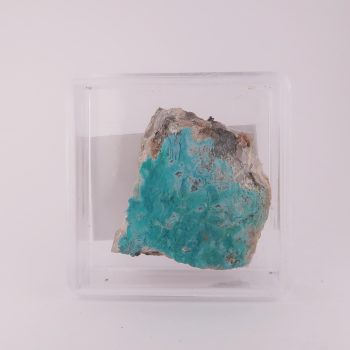
Information about Botallackite
Botallackite is a rare secondary copper chloride mineral and the polymorph least often encountered of the four basic copper chlorides – the others being atacamite, clinoatacamite, and paratacamite, all sharing the same chemical formula but different crystal structures.
It has a particularly strong British identity, being named after one of Cornwall’s most famous and picturesque mine sites, and the type locality remains one of the best sources of collectable material.
It typically forms as small platy, lath-like, or acicular crystals, often aggregated into fan-like stacks or rosette-like formations. It is typically mountain-green to bluish-green in colour, with a vitreous lustre and translucent to transparent crystals. It closely resembles atacamite in both colour and habit.
Botallackite is the least thermodynamically stable of the four basic copper chloride minerals, meaning that under most conditions it will slowly convert into one of the more stable polymorphs over time. In practice, this makes botallackite specimens somewhat less permanent than they appear, and old Cornish material from the 19th century may in some cases have partly or entirely recrystallised to clinoatacamite without any obvious visible change.
It forms in copper-bearing deposits exposed to chloride-rich environments – either coastal marine settings, where seawater provides the chloride, or in highly saline groundwater conditions, where periodic drying and evaporation concentrates chloride solutions to the levels needed for its formation.
It also occurs as a reaction product of copper-bearing smelter slag immersed in seawater, and has been recorded from deep-sea hydrothermal vent deposits – so-called black smoker fields – on the Mid-Atlantic Ridge.
A note for collectors: Reliable identification of the four basic copper chloride polymorphs requires X-ray diffraction. Botallackite in particular should be treated as a provisional identification in the absence of analytical confirmation, as it is both the rarest and least stable of the group, and older collection material labelled as botallackite may in some cases have recrystallised in the interim.
Uses and History
Botallackite has no industrial or gemological applications. It is collected as a mineral specimen, valued for its colour, its delicate crystal habit, and its strong association with the historic Cornish copper mining district.
The mineral was first described in 1865 by the English chemist Arthur Herbert Church and the mineralogist Nevil Story Maskelyne, from specimens collected at the Wheal Cock section of the Botallack Mine in St Just in Penwith, Cornwall – its type locality and the source from which it takes its name.
The mineral was initially thought to be simply another variety of atacamite, and it was not until the structural differences between the copper chloride polymorphs were properly worked out in the mid-20th century that botallackite was confirmed as a distinct species.
Notable localities include the Botallack Mine itself and the nearby Levant Mine and Geevor Mine, all in the St Just district of Cornwall, which collectively represent the classic locality for the mineral worldwide; Cligga Head at Perranporth, also in Cornwall, where unusually large bladed crystals to 6 mm were found on a significant discovery in 2007; the Neath Port Talbot copper works slag locality in South Wales; and the Herzog Julius smelter slag locality at Astfeld in Lower Saxony, Germany, where well-crystallised specimens have been found on slag immersed in water.
Mineralogy
Hazards and Warnings
Toxic mineral: contains copper and chloride. Mineral collectors should wash their hands after handling specimens, to avoid any exposure to potential toxins.
Almost all rocks, minerals (and, frankly, almost all other substances on earth) can produce toxic dust when cutting, which can cause serious respiratory conditions including silicosis. When cutting or polishing rocks, minerals, shells, etc, all work should be done wet to minimise the dust, and a suitable respirator or extraction system should be used.
Translations
Arabic:
Hindi:
Portuguese:
- Botallackita
Bengali:
Indonesian:
Punjabi:
English:
- Botallackite
Italian:
- Botallackite
Russian:
- Боталлакит
French:
- Botallackite
Japanese:
- ボタラック石
Spanish:
- Botallackita
German:
- Botallackit
Korean:
Thai:
Gujurati:
Mandarin Chinese:
Urdu: