
Boracite
Boracite is a magnesium borate mineral, typically found in evaporite deposits, often alongside gypsum, anhydrite, halite, and sylvite.
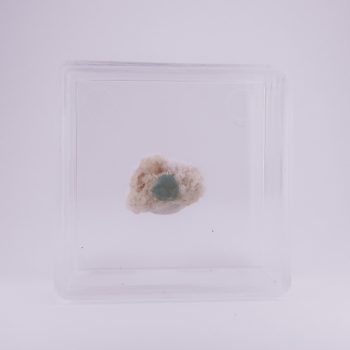
It can form as exceptional singular crystals on matrix, or masses of crystals – sometimes as grains in other minerals.
Showing the single result
Information about Boracite
Boracite is a magnesium borate mineral with some genuinely unusual properties, found almost exclusively in ancient salt and potash deposits laid down by the evaporation of shallow prehistoric seas. It is an uncommon collectors’ mineral, best known for forming attractive pseudo-cubic crystals – that is, crystals whose outward shape mimics a cube despite their internal structure being technically orthorhombic rather than truly cubic – in soft shades of pale blue-green, grey, and colourless.
It typically forms as well-defined crystals showing cubic, tetrahedral, or dodecahedral shapes, usually embedded within or resting on a matrix of gypsum, anhydrite, or halite. Individual crystals are usually small, most commonly a few millimetres, though exceptional examples from the best German localities can reach 15 mm or more. It is typically colourless to pale grey, pale yellow, or pale blue-green, with a vitreous lustre and conchoidal fracture. It has no cleavage, which is unusual for a mineral of this type, and is notably hard for a mineral from an evaporite deposit.
Boracite has two particularly interesting physical properties that are worth noting. It is strongly piezoelectric – meaning it generates a small electrical charge when subjected to mechanical pressure – and strongly pyroelectric – meaning it generates a charge in response to changes in temperature.
Both effects were first observed in boracite before being more extensively studied in other minerals. It is also slowly but completely soluble in water over time, and slowly decomposed by acids, which has implications for the long-term stability of specimens kept in damp conditions.
A note for collectors: Specimens labelled as being from Lunéville in France should be treated with caution. This locality has appeared repeatedly in mineralogical literature as a boracite source, but Mindat’s Best Minerals project notes it is almost certainly a long-running confusion with the type locality at Lüneburg in Germany – the two names being easily confused in older handwritten or printed records. No confirmed boracite has been collected from Lunéville.
Uses and History
Boracite has limited industrial applications, though boron compounds more broadly are used widely in glass and ceramics production, detergents, and agriculture. Boracite itself is occasionally considered as a potential source of boron, and researchers have synthesised analogues of boracite to study their electrical insulating properties and their potential as a storage medium for radioactive iodine – an unusual and niche application that reflects its stable, chloride-bearing structure.
Facetable boracite crystals are exceptionally rare and are found only in the Stassfurt and Hanover districts of Germany, where they occasionally yield small, pale blue-green to colourless gems. Faceted boracite is a genuine rarity in any collection.
The mineral was first described in 1787 by the German mineralogist Georg Siegmund Otto Lasius, from specimens collected at the Kalkberg hill at Lüneburg in Lower Saxony, Germany – its type locality. Lasius initially named the mineral Kubische Quarzkrystalle – meaning “cubic quartz crystals” in German, reflecting his misidentification of the crystal form.
The name boracite, derived from its boron content, was proposed in 1789 by the German geologist Abraham Gottlob Werner, after the pharmacist Johann Friedrich Westrumb established that the mineral contained boric acid. The Lüneburg crystals became immediately popular – collected by mineralogists and children alike, who used the neat cubic crystals as dice.
Remarkably, Mindat records that criminals sentenced to labour in the gypsum quarry also collected and sold them, making boracite one of the very few minerals to feature in the informal prison economy of 18th century Germany. The Kalkberg locality is now protected and collecting is no longer permitted, though small crystals from old collections periodically appear on the market.
Notable localities include Lüneburg and the Stassfurt-Wathlingen-Eime district in Lower Saxony and Saxony-Anhalt, Germany, which has produced the finest and largest crystals known; Inowrocław in the Kujawy salt district of Poland; the Choctaw Salt Dome in Louisiana, USA, where small crystals occur in anhydrite; Bolivia, where rare pink crystals have been found in the Alto Chapare District; and Kazakhstan.
In England, boracite is known from the Boulby Mine at Loftus in North Yorkshire – the UK’s deepest mine, a potash operation that also hosts a world-class dark matter physics research laboratory – where small pseudo-cubic crystals occur in evaporite sequences.
Mineralogy
Hazards and Warnings
No specific health risks have been formally recorded for boracite. Mineral collectors should wash their hands after handling specimens as a matter of good practice.
Specimens should not be stored in damp conditions as boracite is slowly soluble in water, which will in time damage both the crystals and any gypsum or halite matrix.
Almost all rocks, minerals (and, frankly, almost all other substances on earth) can produce toxic dust when cutting, which can cause serious respiratory conditions including silicosis. When cutting or polishing rocks, minerals, shells, etc, all work should be done wet to minimise the dust, and a suitable respirator or extraction system should be used.
Translations
Arabic:
Hindi:
Portuguese:
- Boracita
Bengali:
Indonesian:
Punjabi:
English:
- Boracite
- Stassfurtite (fibrous var.)
Italian:
- Boracite
Russian:
- Борацит
French:
- Boracite
Japanese:
- ボラサイト
Spanish:
- Boracita
German:
- Borazit
- Boracit
- Würfelstein
Korean:
Thai:
Gujurati:
Mandarin Chinese:
- 硼镁石
Urdu: