
Bismuthinite
A bismuth sulphide mineral formed in hydrothermal mineral veins, often alongside other sulphide minerals, native bismuth and native gold.
Some of the needle-like acicular crystals can make excellent micromount specimens.
Showing all 3 results
-
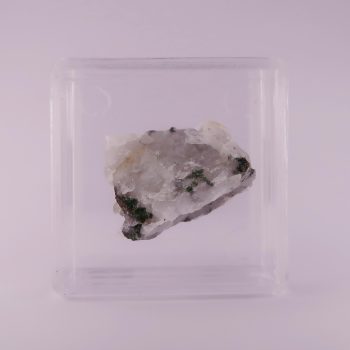
Bismuthinite from Binner Downs Mine, Cornwall
£5.00 -
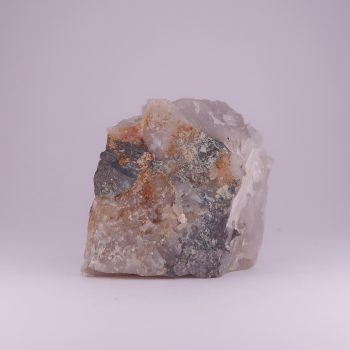

Bismuthinite from Carrock Mine, Cumbria
£15.00 -
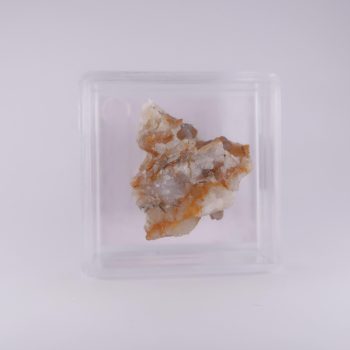
Bismuthinite from Ödenkar, Austria
£10.00
Information about Bismuthinite
Bismuthinite is a bismuth sulphide mineral and the principal ore of bismuth – the soft, low-melting metal perhaps best known today for the spectacular rainbow-coloured hopper crystals produced synthetically and widely sold in the mineral trade.
Bismuthinite itself is altogether more understated in appearance, but is a respectable mineral specimen in its own right, and its association with gold, tin, and tungsten ore deposits gives it an interesting geological context.
It typically forms as long, striated prismatic crystals – often strikingly similar in habit to stibnite, with which it can be confused – and also as foliated, fibrous, or granular masses. It is typically lead-grey to pewter-white in colour on a fresh surface, but the surface often develops a yellowish, iridescent, or rainbow tarnish on exposure to air, which can actually make older specimens more visually appealing than fresh ones. It has a bright metallic lustre and is noticeably heavy for its size.
Bismuthinite is primarily a high-temperature hydrothermal mineral – that is, it forms from hot mineral-rich fluids deep within the crust – and is most commonly found in association with granite-related tin and tungsten ore deposits, gold-bearing veins, and sometimes in pegmatites. It frequently occurs alongside native bismuth, arsenopyrite, cassiterite, wolframite, chalcopyrite, and quartz. On weathered outcrops it readily alters to bismutite, a pale yellow secondary bismuth carbonate, which can serve as a useful surface indicator of bismuthinite at depth.
It forms a continuous solid-solution series with stibnite (the antimony equivalent), through which bismuth and antimony substitute for one another in varying proportions. It is also closely related to aikinite and a number of other lead-copper-bismuth sulphosalts, with which it frequently intergrows.
Uses and History
Bismuthinite is an important ore mineral of bismuth, a metal with a surprisingly wide range of applications given its relatively low profile. Bismuth is used in low-melting alloys for fire safety systems and fusible links; in pharmaceuticals, most notably as the active ingredient in indigestion medications that may or may not rhyme with “Smepto-Smismol”; as a non-toxic replacement for lead in some solders, shot, and fishing weights; in cosmetics, where bismuth oxychloride produces a pearlescent shimmer in eyeshadows and foundation; and in the production of certain semiconductors and thermoelectric devices. Although bismuth is not abundant, it is predominantly recovered as a by-product of lead, copper, and tin smelting rather than mined directly, so bismuthinite rarely drives mining operations in its own right.
The mineral was named in 1832 for its composition – the name being a straightforward reference to its bismuth content – and the type locality is the Cerro Tazna deposit in the Potosí Department of Bolivia, a historically important mining region. Bolivia remains one of the most significant sources of bismuth globally.
Notable localities for collectable specimens include the Tazna Mine in Bolivia, which has produced fine silvery prismatic crystals; Příbram and other localities in the Czech Republic; various tin and tungsten districts in Cornwall and Devon in England, where bismuthinite is a well-known accessory mineral in the granite-hosted lodes; Llallagua in Bolivia; Dalnegorsk in Russia; and localities in Norway, Romania, Australia, and Madagascar.
In Wales, bismuthinite has been confirmed from Parys Mountain on Anglesey, where microscopic grains associated with native bismuth have been identified in complex sulphide ore; from at least two mines in the Dolgellau Gold Belt in Gwynedd, where it occurs in gold-bearing veins; from the Snowdon Caldera copper-bearing veins; and from the Castell Carn Dochan Mine near Bala. The Dolgellau Gold Belt occurrences are of particular interest given bismuthinite’s well-known association with gold mineralisation worldwide.
Mineralogy
Hazards and Warnings
Toxic mineral: contains bismuth and sulphur. Bismuth itself has low toxicity relative to many other heavy metals, but it is not entirely benign and good hygiene practice should be maintained. Mineral collectors should wash their hands after handling specimens as a matter of good practice.
Almost all rocks, minerals (and, frankly, almost all other substances on earth) can produce toxic dust when cutting, which can cause serious respiratory conditions including silicosis. When cutting or polishing rocks, minerals, shells, etc, all work should be done wet to minimise the dust, and a suitable respirator or extraction system should be used.
Translations
Arabic:
Hindi:
Portuguese:
- Bismutinita
Bengali:
Indonesian:
Punjabi:
English:
- Bismuthinite
- Bismuth Glance
Italian:
- Bismutinite
Russian:
- Висмутин
French:
- Bismuthinite
Japanese:
- 輝蒼鉛鉱
Spanish:
- Bismutinita
German:
- Bismuthinit
- Wismutglanz
Korean:
Thai:
Gujurati:
Mandarin Chinese:
- 辉铋矿
Urdu: