
Bindheimite
Bindheimite is a lead antimony oxide hydroxide mineral formed as part of the oxidising zone of antimony/lead deposits. Typically forms as a yellow, earthy crust.
It is possible that Bindheimite and Oxyplumboroméite are the same mineral but this is still under debate.
Toxic mineral: contains lead, antimony.
Showing the single result
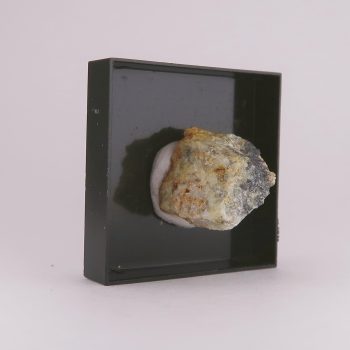
Information about Bindheimite
Bindheimite is a secondary lead antimonate mineral – that is, it forms at or near the surface through the weathering and breakdown of pre-existing antimony- and lead-bearing sulphide minerals such as jamesonite, tetrahedrite, and galena. It is widely distributed in small quantities and is a relatively familiar sight on specimens from lead and antimony ore deposits, typically occurring as dull yellow to ochre powdery crusts and earthy masses.
It is typically canary-yellow to ochre, pale yellow, yellowish-brown, or occasionally white or grey, with a resinous to dull earthy lustre. Well-crystallised specimens are uncommon; bindheimite more usually occurs as powdery coatings, earthy masses, or crusts lining cavities in heavily weathered rock.
Occasional specimens show cubic or pseudo-cubic pseudomorphs – meaning that the bindheimite has replaced the original mineral crystal by crystal, preserving the outward shape while completely changing the internal composition.
A note on its mineral status: Bindheimite sits in an uncertain position in modern mineralogy. Mindat currently lists it as a material that is not an approved mineral species, noting that much of what has historically been described as bindheimite may correspond instead to the more recently defined mineral oxyplumboroméite, or to related members of the pyrochlore supergroup.
The two cannot be reliably distinguished in the field or even by routine analysis, and significant further study of individual occurrences would be needed to resolve the picture fully. As a result, the name bindheimite remains widely used in the collector community for practical purposes, but some caution is warranted when interpreting older collection labels or locality records.
Uses and History
Bindheimite has no industrial applications and no gemological uses. It is of interest primarily to collectors of secondary lead minerals and to those with an interest in the mineralogy of specific ore districts.
The mineral was named in honour of Johann Jacob Bindheim (1750-1825), a German chemist who carried out the first detailed chemical analysis of the mineral. Its exact history of description is somewhat tangled given the questions around its precise identity, but the name has been in use since the early 19th century.
Notable localities include the Clara Mine at Oberwolfach in the Black Forest, Germany; Hüttenberg in Carinthia, Austria; the Caldbeck Fells in Cumbria, England, where bindheimite is a common secondary mineral at numerous mines including Brae Fell, Red Gill, Balliway Rigg, and Silver Gill, typically forming yellow powdery crusts in cavities in quartz alongside cerussite, anglesite, leadhillite, and other secondary lead minerals; and Wet Swine Gill, also in Cumbria, where it has been found coating native antimony.
In Wales, bindheimite is particularly widespread across the Central Wales Orefield, where it is one of the most commonly encountered secondary minerals. Well-documented Welsh localities include Frongoch Mine near Devil’s Bridge and Logaulas Mine in Ceredigion – both rich sites where bright yellow powdery bindheimite liberally coats cerussite-lined cavities in heavily weathered galena-rich rock – and Bwlch Mine at Deganwy in Gwynedd, where it has been recorded replacing both semseyite and stibnite. Cubic pseudomorphs after ullmannite have been noted at Hendrefelin, Frongoch, and Mynyddgorddu mines.
Mineralogy
Note: much material described as bindheimite may be oxyplumboroméite or related pyrochlore supergroup members – precise identification requires laboratory analysis.
Hazards and Warnings
Toxic mineral: contains lead and antimony. Mineral collectors should wash their hands thoroughly after handling specimens, to avoid any exposure to potential toxins. The powdery, friable nature of most bindheimite means it can produce fine dust very easily – handle with care. Specimens should be stored safely away from children and food preparation areas.
Almost all rocks, minerals (and, frankly, almost all other substances on earth) can produce toxic dust when cutting, which can cause serious respiratory conditions including silicosis. When cutting or polishing rocks, minerals, shells, etc, all work should be done wet to minimise the dust, and a suitable respirator or extraction system should be used.
Translations
Arabic:
Hindi:
Portuguese:
- Bindheimita
Bengali:
Indonesian:
Punjabi:
English:
- Bindheimite
Italian:
- Bindheimite
Russian:
- Биндгеймит
French:
- Bindheimite
Japanese:
Spanish:
- Bindheimita
German:
- Bindheimit
Korean:
Thai:
Gujurati:
Mandarin Chinese:
Urdu: