
Beudantite
Beudantite is a secondary polymetallic mineral, specifically a lead iron arsenate sulphate mineral. Bit complex, eh?
Toxic mineral: contains arsenic, lead.
Showing all 2 results
-
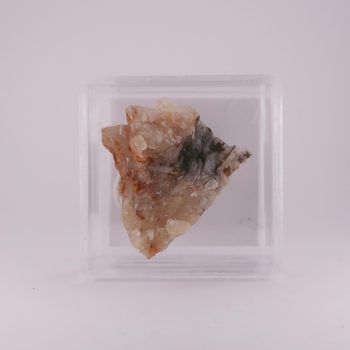
Beudantite from Silberbrünnle Mine, Germany
£15.00 -
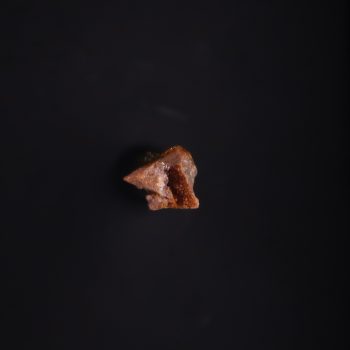

Carminite and Beudantite from Brandy Gill Mine, Cumbria
£5.00
Information about Beudantite
Beudantite is a rare lead iron arsenate sulphate mineral, forming as small but often beautifully shaped crystals in the weathered, oxidised zones of lead-bearing ore deposits. It is a collectors’ mineral with no commercial importance, valued for its unusually varied crystal forms and its wide range of colours.
It typically forms as tabular, rhombohedral, or pseudo-cubic crystals – that is, crystals whose shape mimics a cube despite not strictly having that structure. It is typically yellow to yellow-green, green, or brown, though reddish and near-black specimens are also known, and the colour can vary considerably even within a single locality. It has a vitreous to resinous lustre, and well-formed crystals are translucent to transparent.
Beudantite forms where lead-bearing sulphide ore deposits have been exposed to weathering at or near the surface, and both arsenic and sulphate are present in the surrounding groundwater.
It is a member of the beudantite group within the larger alunite supergroup, and forms a continuous solid solution – that is, a chemically gradational series without a sharp boundary – with segnitite (where arsenic dominates over sulphate) and with plumbojarosite (where sulphate dominates). This can make precise identification tricky without laboratory analysis.
It is also the arsenate equivalent of corkite, where phosphate takes the place of arsenate in the structure.
Uses and History
Beudantite has no industrial applications and is too soft and uncommon for use in jewellery. It is collected purely as a mineral specimen, often alongside other colourful secondary minerals from the same oxidised ore zones.
The mineral was first described in 1826 by the French crystallographer Armand Lévy, from specimens collected at the Louise Mine in the Westerwald district of Rhineland-Palatinate, Germany – its type locality. Lévy named it in honour of his fellow Frenchman François Sulpice Beudant (1787-1850), Professor of Mineralogy at the University of Paris, who was a systematic mineralogist responsible for introducing a number of mineral names that remain in use today.
Notable localities include the Clara Mine at Oberwolfach in the Black Forest, Germany, which has produced sharply crystallised specimens to 4 mm or more on quartz matrix; Tsumeb in Namibia, another consistently fine source; Lavrion in Greece, where beudantite occurs in association with other secondary lead minerals; and the Ojuela Mine at Mapimí in Durango, Mexico.
In England, beudantite has been recorded from Cornwall, including at Hingston Down Consols near Callington, and from several localities in Devon. In Wales, verified occurrences are known from the Darren Mine at Pen-bont Rhydybeddau in Ceredigion, where green-brown crusts of minute globular aggregates occur with yellow beaverite and cerussite; from Dolyhir Quarry at Old Radnor in Powys, where tiny yellow euhedral crystals were collected from a sulphide vein; and from Ystrad Einion Mine near Furnace in Ceredigion, where transparent yellow-green rhombohedral crystals form sparkling crusts on goethite – all confirmed by X-ray diffraction or electron microprobe analysis.
Mineralogy
Hazards and Warnings
Toxic mineral: contains lead and arsenic. Mineral collectors should wash their hands thoroughly after handling specimens, to avoid any exposure to potential toxins. Specimens should be stored safely away from children and food preparation areas.
Almost all rocks, minerals (and, frankly, almost all other substances on earth) can produce toxic dust when cutting, which can cause serious respiratory conditions including silicosis. When cutting or polishing rocks, minerals, shells, etc, all work should be done wet to minimise the dust, and a suitable respirator or extraction system should be used.
Translations
Arabic:
Hindi:
Portuguese:
- Beudantita
Bengali:
Indonesian:
Punjabi:
English:
- Beudantite
Italian:
Russian:
- Бедантит
French:
Japanese:
Spanish:
- Beudantita
German:
- Beudantit
Korean:
Thai:
Gujurati:
Mandarin Chinese:
- 砷菱铅矾
Urdu: