
Baumhauerite
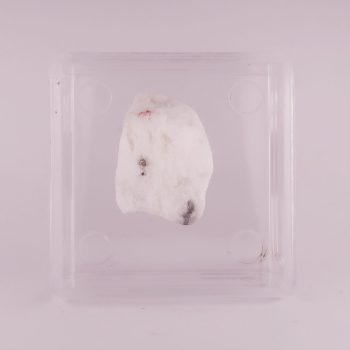
Baumhauerite is a rare lead arsenic sulphosalt mineral usually seen as metallic grey to black crystalline masses rather than sharp individual crystals.
Its scarcity and classic Alpine associations make even small examples desirable to species collectors.
Showing the single result
Information about Baumhauerite
Baumhauerite is a rare lead arsenic sulphosalt mineral – a member of a chemically complex group of minerals in which lead and arsenic are combined with sulphur in varying proportions. It is a collectors’ mineral with essentially no commercial importance, prized entirely for its scientific interest and for the remarkable locality with which it is almost exclusively associated.
It typically occurs as small, striated prismatic crystals embedded in white dolomitic marble, and is typically lead-grey to bluish-grey in colour with a metallic to dull lustre. One of its more unusual characteristics is a tendency to show brief reddish internal reflections when light catches it at certain angles – a subtle but distinctive feature that can help with identification.
Baumhauerite belongs to the sartorite homologous series, a group of structurally related lead arsenic sulphosalts that are the subject of ongoing scientific study. Related minerals include dufrénoysite, gratonite, and sartorite, all of which share similar structural building blocks arranged in different combinations. A silver-bearing relative, argentobaumhauerite (formerly known as baumhauerite-2a), also occurs at the same locality.
Uses and History
Baumhauerite has no industrial or gemological applications whatsoever. It is collected purely for its scientific significance and its exceptionally close association with one of the most celebrated mineral localities on earth.
The mineral was first described in 1902 by the British mineralogist Richard Harrison Solly, from specimens collected at the Lengenbach Quarry in the Binntal – the Binn Valley – in the Valais canton of Switzerland. It was named in honour of Professor Heinrich Adolf Baumhauer (1848-1926) of the University of Fribourg, Switzerland, who had worked extensively on the unusual minerals of that same locality.
The Lengenbach Quarry deserves a word of its own. It is a small working in a lens of pale dolomitic marble high in the Swiss Alps, and it is arguably the single most scientifically important locality for rare sulphosalt minerals in the world. Dozens of minerals have been described from Lengenbach and nowhere else, many of them chemically extraordinary and found in crystals measuring only a few millimetres. The quarry has been worked for scientific specimens since the mid-19th century and continues to yield new discoveries to this day. A baumhauerite specimen from Lengenbach is, for many collectors, a prized acquisition simply by virtue of its provenance.
Outside Switzerland, baumhauerite has been recorded at Sterling Hill in New Jersey, USA, typically associated with molybdenite; and at Hemlo in Ontario, Canada. A further occurrence has been documented in the Salzburg region of Austria. These localities are minor by comparison and have not produced collectable specimens of note.
Mineralogy
Hazards and Warnings
Toxic mineral: contains lead and arsenic. Mineral collectors should wash their hands thoroughly after handling specimens, to avoid any exposure to potential toxins. Specimens should be stored safely away from children and food preparation areas.
Almost all rocks, minerals (and, frankly, almost all other substances on earth) can produce toxic dust when cutting, which can cause serious respiratory conditions including silicosis. When cutting or polishing rocks, minerals, shells, etc, all work should be done wet to minimise the dust, and a suitable respirator or extraction system should be used.
Translations
Arabic:
Hindi:
Portuguese:
- Baumhauerita
Bengali:
Indonesian:
Punjabi:
English:
- Baumhauerite
Italian:
- Baumhauerite
Russian:
- Баумгауэрит
French:
- Baumhauerite
Japanese:
- バウムハウエル鉱
Spanish:
- Baumhauerita
German:
- Baumhauerit
Korean:
Thai:
Gujurati:
Mandarin Chinese:
- 褐硫砷铅矿
Urdu: