
Asbolane
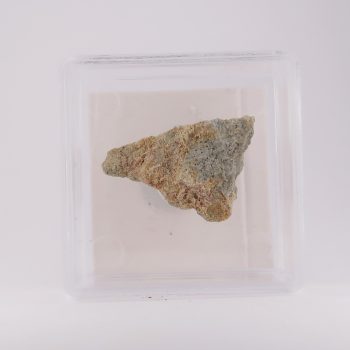
Asbolane is a poorly defined mineral, typically consisting of a cobalt or nickel bearing manganese ‘wad’ material.
It is typically a dull to earthy brown to blue-black, and is often a crust but sometimes botryoidal.
Showing the single result
Information about Asbolane
Asbolane is a rather unusual entry in any mineral catalogue, because it is not a single, well-defined mineral in the way that most others are. It is best described as a poorly crystalline, highly variable black manganese oxide that contains significant amounts of cobalt, nickel, and sometimes copper – but in proportions that vary so widely between specimens that its exact chemistry is essentially never the same twice.
It most commonly occurs as dull, sooty black earthy masses, crusts, or nodules with no obvious crystal form. It is typically jet black to dark brownish-black, with a dull to earthy lustre. It is soft enough to leave a black smear on the fingers – indeed, its name comes directly from the Greek for “to soil like soot.”
Asbolane forms at the surface or near-surface through the prolonged weathering and breakdown of cobalt- and nickel-bearing rocks. As manganese oxides are notoriously effective at absorbing and concentrating metals from surrounding groundwater, the resulting material can accumulate economically significant levels of cobalt and nickel – making asbolane of considerable interest to the mining industry even if it frustrates the mineralogist.
Its uncertain status as a mineral species reflects a broader challenge in mineralogy: at what point does a poorly crystalline, chemically inconsistent natural substance become a defined mineral?
Asbolane was named by the German mineralogist August Breithaupt in 1847, but it has never been formally approved as a valid species by the IMA (the International Mineralogical Association, the body responsible for recognising minerals), and its type locality is not definitively established.
It is likely that what is called asbolane in the field is often a mixture of related manganese oxide minerals, and some authorities suggest it may eventually be split into several properly defined species as analytical methods improve.
Uses and History
Despite its uncertain mineralogical status, asbolane has a long history as an ore mineral. It has been mined as a source of cobalt since at least the 18th century, when cobalt was increasingly in demand as a blue colourant for glass, ceramics, and paint – the celebrated cobalt blue pigment used by generations of artists and potters being derived from cobalt compounds.
In more recent times, cobalt has become strategically important for rechargeable batteries, superalloys, and electronics, and asbolane remains a significant cobalt and nickel ore mineral in laterite deposits in parts of Central Africa, New Caledonia, and Australia.
Asbolane was known historically under various names including cobaltum nigrum (black cobalt) and Kobalt Erde (cobalt earth) before Breithaupt gave it its current name in 1847.
Notable localities include the nickel and cobalt laterite deposits of New Caledonia, which are among the most significant in the world; the Katanga (Shaba) province of the Democratic Republic of the Congo; Schneeberg in Saxony, Germany, one of the great historic mining districts of Europe; the White Canyon Mining District of Utah, USA; and the Lipovka area of the Ural Mountains, Russia. In Wales, asbolane was worked as a low-grade ore of nickel and cobalt at a mine near Dyserth in Clwyd during the late 19th century, and a zinc-bearing variety has been recorded from abandoned lead and zinc mines in Gwynedd.
Mineralogy
Hazards and Warnings
Toxic mineral: contains cobalt, nickel, and manganese, all of which are toxic in quantity. The earthy, friable nature of asbolane means it can produce fine dust very easily – handle with care and wash hands thoroughly after handling.
Almost all rocks, minerals (and, frankly, almost all other substances on earth) can produce toxic dust when cutting, which can cause serious respiratory conditions including silicosis. When cutting or polishing rocks, minerals, shells, etc, all work should be done wet to minimise the dust, and a suitable respirator or extraction system should be used.
Translations
Arabic:
Hindi:
Portuguese:
- Asbolana
Bengali:
Indonesian:
Punjabi:
English:
- Asbolane
- Asbolan
- Asbolite
Italian:
- Asbolano
Russian:
- Асболан
French:
- Asbolane
Japanese:
Spanish:
- Asbolana
German:
- Asbolan
- Kobalt Erde
Korean:
Thai:
Gujurati:
Mandarin Chinese:
Urdu: