
Artinite
Artinite is a delicate magnesium carbonate mineral typically forming white, silky needles or radiating sprays.
It can be incredibly fragile, so most specimens are small and careful handling is highly recommended.
Showing the single result
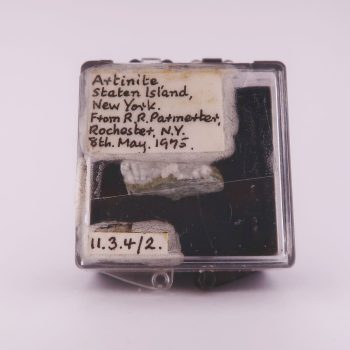
Information about Artinite
Artinite is a rare magnesium carbonate mineral that forms as a secondary, low-temperature alteration product in certain magnesium-rich rocks. It is particularly admired by collectors for its snow-white, needle-like crystals, which typically form in delicate spherical clusters or radiating tufts resembling tiny sea urchins.
It is typically pure white to colourless, occasionally very pale grey, with a silky to vitreous lustre. Crystals are usually transparent to translucent, and the finest specimens can be almost glass-like in appearance despite their fragility.
Artinite forms where magnesium-rich rocks – most commonly serpentinite, a rock produced by the alteration of certain deep-seated igneous rocks – have been further weathered and altered by the action of water and carbon dioxide. In this sense it is part of a natural process by which rocks slowly absorb carbon dioxide from the atmosphere over geological timescales. It commonly occurs alongside brucite, hydromagnesite, pyroaurite, chrysotile, aragonite, and calcite.
A note for collectors: Artinite specimens require careful storage. With a very low hardness and a relatively high water content, specimens can dehydrate, become brittle, or lose their silky lustre if exposed to strong heat, prolonged direct sunlight, or very dry air. Keeping specimens in a sealed display case or a small box with gentle humidity control is strongly recommended.
Uses and History
Artinite has no industrial or gemological applications and is far too soft and fragile for use in jewellery. It is collected purely for its scientific interest and for the considerable beauty of its delicate white crystal clusters.
The mineral was first described in 1902 by the Italian mineralogist S.C. Luigi Brugnatelli, from specimens collected in the Dossi di Franscia asbestos mines in Lombardy, northern Italy – its type locality. It was named in honour of Ettore Artini (1866-1928), Professor of Mineralogy at the University of Milan, who had contributed significantly to Italian mineralogical research.
The finest known specimens come from the New Idria and Gem mines in San Benito County, California, USA, where radiating clusters up to 2 cm across have been collected. Other notable localities include Val Malenco and other serpentinite districts in northern Italy; Staten Island and Hoboken in New Jersey, USA, where artinite was discovered in former asbestos mines; the Alban Hills near Rome, Italy; and Kraubath in Styria, Austria. It has not been formally recorded from the United Kingdom.
Mineralogy
Hazards and Warnings
No specific health risks have been formally recorded for artinite. Mineral collectors should wash their hands after handling specimens as a matter of good practice.
Almost all rocks, minerals (and, frankly, almost all other substances on earth) can produce toxic dust when cutting, which can cause serious respiratory conditions including silicosis. When cutting or polishing rocks, minerals, shells, etc, all work should be done wet to minimise the dust, and a suitable respirator or extraction system should be used.
Translations
Arabic:
Hindi:
Portuguese:
- Artinita
Bengali:
Indonesian:
Punjabi:
English:
- Artinite
Italian:
- Artinite
Russian:
- Артинит
French:
- Artinite
Japanese:
- アルティナイト
Spanish:
- Artinita
German:
- Artinit
Korean:
Thai:
Gujurati:
Mandarin Chinese:
Urdu: