
Ancylite
Ancylite is a rare carbonate mineral rich in rare earth elements (especially cerium and lanthanum), typically found in hydrothermal veins and known for its importance as a source of light rare earth metals.
Showing the single result
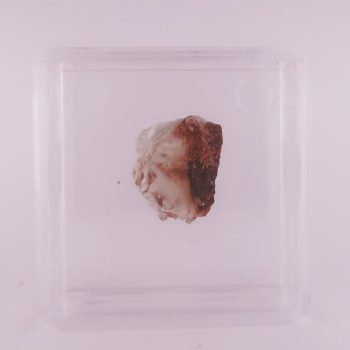
Information about Ancylite
The Ancylite group is a group of rare strontium and calcium rare earth carbonate minerals, typically forming small, stubby to elongated crystals with distinctively curved and rounded faces – a feature so characteristic that it gave the mineral its name.
It is typically grey to pale yellow, pinkish, or brownish in colour, with a vitreous lustre. Crystals tend to be small, and showy specimens are relatively uncommon, making well-crystallised examples particularly appealing to collectors.
Ancylite forms as an accessory mineral in unusual alkaline igneous rocks and their associated pegmatites, where it commonly occurs alongside minerals such as bastnäsite, nenadkevichite, and calcite. It is an important concentrator of light rare earth elements and strontium.
The group includes ancylite-(Ce), ancylite-(La), and calcioancylite-(Ce) among its members, named according to the dominant rare earth element or calcium content in their composition. Ancylite-(Ce), the cerium-dominant species, is by far the most frequently encountered.
Uses and History
Ancylite has no industrial or gemological applications and is collected purely for its scientific interest and the charm of its unusual, curved crystal forms.
The mineral was first described in 1899 by the Swedish mineralogist Gustaf Flink, from specimens collected at the Narsarsuk pegmatite in southern West Greenland – its type locality. It was named from the Greek word ankylos, meaning “curved”, in direct reference to the rounded and distorted crystal shapes commonly seen at that locality.
Notable localities include the Poudrette quarry at Mont Saint-Hilaire in Quebec, Canada, which has produced some of the finest and most recognisable specimens; Heimsjø in Trøndelag, Norway; the Khibiny and Lovozero massifs on the Kola Peninsula in Russia; and various localities in China, Brazil, and the Democratic Republic of the Congo. Calcioancylite-(Ce) has been recorded from the Guisachan Quarry in Sutherland, Scotland.
Mineralogy
Hazards and Warnings
No specific health risks have been formally recorded for ancylite. Mineral collectors should wash their hands after handling specimens as a matter of good practice.
Almost all rocks, minerals (and, frankly, almost all other substances on earth) can produce toxic dust when cutting, which can cause serious respiratory conditions including silicosis. When cutting or polishing rocks, minerals, shells, etc, all work should be done wet to minimise the dust, and a suitable respirator or extraction system should be used.
Translations
- Ancylite
- Ancilite
- Анцилит
- Ancilita
- Ancylit
- 碳锶铈矿