
Adamsite-Y
Adamsite-Y is a rare earth silicate mineral containing yttrium.
Its type locality is the Poudrette Quarry, Mont-Saint Hilaire, Canada.
Showing the single result
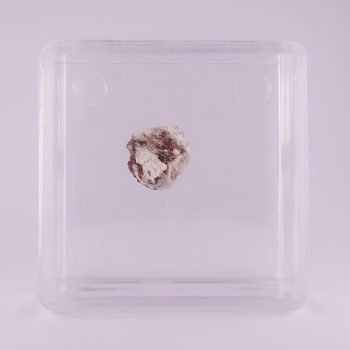
Information about Adamsite-(Y)
Adamsite-(Y) typically occurs as flat, needle-like to fibrous crystals, often forming delicate spherical or radiating clusters.
It is colourless to white, occasionally pale pink, and rarely pale purple, with a glassy to pearly lustre.
It forms at low temperatures in the late stages of crystallisation within unusual alkaline igneous rocks. It is chemically similar to several other rare yttrium carbonate minerals, including shomiokite-(Y) and lecoqite-(Y).
Uses and History
Adamsite-(Y) has no industrial or gemological applications. It is exclusively a collectors species, valued for its rarity and its delicate, fibrous crystal habit.
It was first described in 2000 by Grice, Gault, Roberts, and Cooper, from specimens collected at the Poudrette quarry at Mont Saint-Hilaire, Quebec, Canada – its type locality, and the site most closely associated with the mineral. Only two other localities are currently known: Hundholmen in Nordland, Norway, and the Lovozero massif on the Kola Peninsula, Russia.
Adamsite-(Y) is named in honour of Professor Frank Dawson Adams (1859-1942) of McGill University, Montreal, a geologist and petrologist who studied the Monteregian Hills, of which Mont Saint-Hilaire is a member.
The suffix -(Y) indicates that yttrium is the predominant rare earth element in its structure.
It should not be confused with Adamsite, which is an unrelated variety of muscovite, or Adamite, a zinc-arsenate mineral.
Mineralogy
Colourless, white, pale pink, pale purple.
Hazards and Warnings
Mineral collectors should wash their hands after handling specimens, to avoid any exposure to potential toxins.
Almost all rocks, minerals (and, frankly, almost all other substances on earth) can produce toxic dust when cutting, which can cause serious respiratory conditions including silicosis.
When cutting or polishing rocks, minerals, shells, etc, all work should be done wet to minimise the dust, and a suitable respirator or extraction system should be used.
Translations
Arabic:
Hindi:
Portuguese:
Bengali:
Indonesian:
Punjabi:
English:
- Adamsite-(Y)
Italian:
Russian:
- Адамсит-(Y)
French:
Japanese:
Spanish:
German:
- Adamsit-(Y)
Korean:
Thai:
Gujurati:
Mandarin Chinese:
Urdu:
Further Reading / External Links
- https://en.wikipedia.org/wiki/Adamsite-(Y)
- https://www.mindat.org/min-7088.html
- https://www.dakotamatrix.com/mineralpedia/8678/adamsite-y
- https://webmineral.com/data/Adamsite-(Y).shtml