
Dendrites
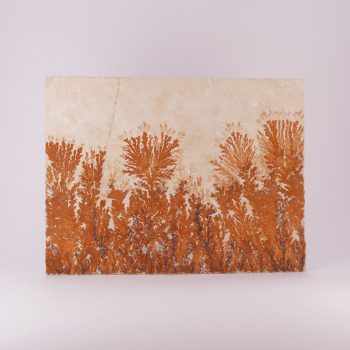
Dendrites are a form of crystal which grow outwards into a fractal branching form. Snowflakes and frost are technically forms of dendrite, but obviously rather short lived.
Iron and manganese tend to be responsible for the types of dendrites we find in natural mineral forms – particularly the psilomelane manganese dendrites found in limestones and sandstones.
Showing the single result
Information about Dendrites
Dendrites, in the mineral collecting sense, refer to the distinctive fern-like, tree-like, or moss-like black or brown branching patterns found on the surfaces of rocks and minerals, most commonly on bedding planes and fracture surfaces of sedimentary rocks such as limestone, sandstone, and chert, or on polished slabs of agate, jasper, and other silica-rich stones.
Despite their remarkably life-like appearance – which has fooled observers for centuries into believing they represent fossil plants or mosses – dendrites are entirely inorganic mineral formations, not biological remains.
The branching patterns are formed by the diffusion and precipitation of iron and manganese oxide minerals along flat surfaces and within thin fracture planes. As metal-rich groundwaters percolate slowly through rock along partings and fractures, iron and manganese ions are deposited as oxides when the geochemical conditions change – typically through oxidation or a change in pH.
The resulting patterns mimic the branching structure of plants through a purely physical process: a phenomenon known in mathematics and materials science as fractal self-similarity, where the same pattern repeats at different scales. The principal minerals forming dendrites are pyrolusite (MnO2, usually responsible for black dendrites), romanèchite, hollandite, and goethite or limonite (FeO·OH, usually responsible for brown dendrites).
The most familiar and prized dendritic material commercially is dendritic agate, where dendrites are enclosed within translucent chalcedony, and dendritic limestone (also called Solnhofen limestone or similar) from which polished slabs reveal spectacular arboreal patterns on pale cream backgrounds.
Uses and History
Dendrites have fascinated observers since antiquity. The ancient Greeks termed them dendrites lithos (tree stones), and medieval European scholars commonly interpreted them as fossil plants or as evidence of the generative power of the earth – a misidentification that persisted well into the 18th century. The Swiss naturalist Conrad Gessner illustrated what are clearly dendrites in his 1565 work on fossils, treating them as plant remains.
By the late 18th century, the inorganic origin of dendrites had been established, and they have been collected as curiosities and used in jewellery, inlay work, and decorative arts for centuries.
Dendritic agate and dendritic limestone have been used for cameos, seals, tabletops, and decorative panels; the finest dendritic limestones from Germany and Switzerland can command significant prices as collector slabs.
Notable sources of dendritic limestone include Solnhofen in Bavaria, Germany (the same deposit famous for its Archaeopteryx fossils and a huge range of other fossils); the Jurassic limestones of the Jura mountains in France and Switzerland; and various sedimentary sequences in Morocco and Iran, which produce large polished slabs with striking black dendritic patterns.
Dendritic agate is found worldwide in volcanic sequences where manganese-bearing fluids have percolated through chalcedony-forming cavities, with notable sources in India, Brazil, USA, and Uruguay.
In Wales, dendritic manganese-oxide coatings on limestone bedding planes are a common occurrence in the Carboniferous limestone sequences of South Wales and North Wales, and on bedding surfaces within the Old Red Sandstone of the Welsh Borderland, though such material is typically collected as curiosities rather than as mineral specimens in the formal sense.
Mineralogy
Hazards and Warnings
No specific toxicological hazards are associated with dendrites in typical collector specimens. Manganese dust should not be inhaled in quantity, and hands should be washed after handling. Standard cutting dust precautions apply when polishing dendritic agate or lapidary material.
Almost all rocks, minerals (and, frankly, almost all other substances on earth) can produce toxic dust when cutting, which can cause serious respiratory conditions including silicosis. When cutting or polishing rocks, minerals, shells, etc, all work should be done wet to minimise the dust, and a suitable respirator or extraction system should be used.
Translations
Arabic:
- دنيدريت
Hindi:
Portuguese:
- Dendrites
Bengali:
Indonesian:
- Dendrit
Punjabi:
English:
- Dendrites
Italian:
- Dendriti
Russian:
- Дендриты
French:
- Dendrites
Japanese:
- デンドライト
Spanish:
- Dendritas
German:
- Dendriten
Korean:
- 덴드라이트
Thai:
Gujurati:
Mandarin Chinese:
- 树枝石
Urdu: