
Amethyst
This beautiful stone is a gorgeous purple variety of Quartz, and is one of the most well known and well loved gemstones.
In jewellery, it is used in almost every possible way – sold rough, polished, cut into cabochons and even occasionally faceted.
-
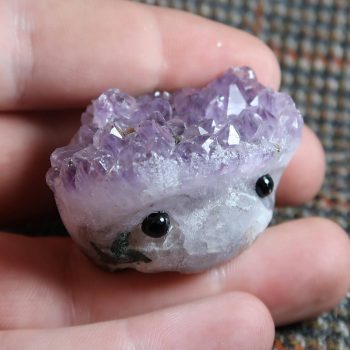

Amethyst Carvings (2)
-
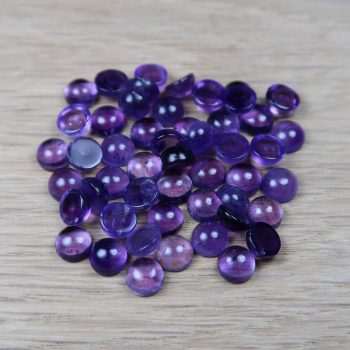
Amethyst for Jewellers (8)
-
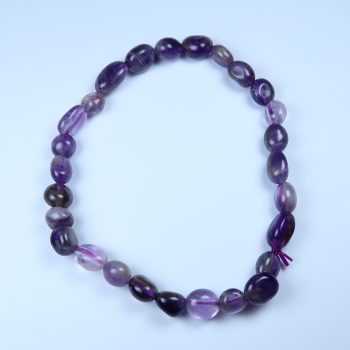
Amethyst Jewellery (1)
-
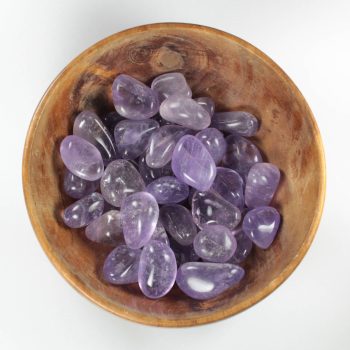
Amethyst Tumblestones (2)
-
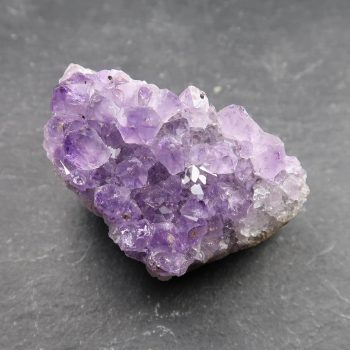
Rough Amethyst (15)
Information about Amethyst
Amethyst is the purple variety of quartz, and one of the most widely recognised and historically significant of all gemstones – a mineral that for two thousand years was ranked among the cardinal gems alongside diamond, ruby, sapphire, and emerald, and whose sudden demotion to semi-precious status in the nineteenth century resulted not from any change in the stone itself but simply from the discovery of Brazilian and Uruguayan deposits so enormous that the prior scarcity that had driven its value was simply abolished. Today amethyst is among the most affordable of all gem-quality minerals for its size, colour, and beauty combined.
The purple colour is caused by irradiation-induced colour centres involving iron (Fe3+) substituting for silicon in the quartz crystal structure. Specifically, the colour arises when iron at silicon lattice sites is exposed to natural gamma radiation from the surrounding rock, producing [FeO4]0 colour centres that absorb light in the yellow-green part of the spectrum, leaving the violet to be transmitted and perceived. The same mechanism can be triggered artificially by irradiating iron-bearing colourless quartz in a laboratory – and conversely, the colour can be destroyed by heating, which is why amethyst turns yellow, orange, or brown at around 470-550°C to produce what is sold as heat-treated citrine. A small number of amethyst deposits contain material that turns green rather than yellow on heating, producing prasiolite.
The colour of amethyst is typically distributed unevenly through a crystal, concentrated in phantom-like zones under the rhombohedral faces at crystal tips, or in parallel growth banding through the prism. The highest-quality amethyst – called deep Russian or deep Siberian in the trade – has a primary purple hue at approximately 75-80% intensity with secondary blue and red tones under different lighting. Rose de France is the trade name for the palest, most lavender to lilac-tinted material.
Colour-change amethyst, shifting between purple in daylight and reddish-purple in incandescent light, is known from some African sources – however, it is the exception rather than the norm.
Uses and History
Amethyst has one of the longest documented histories of use of any gemstone. Its name derives from the Greek amethystos, meaning “not drunk” – the ancient Greeks and Romans attributed to amethyst the power to prevent intoxication, and wine goblets were often carved from it or lined with it for this supposed purpose.
The sobering property was perhaps a post-hoc rationalisation of the wine-like purple colour, though Pliny the Elder in his Natural History discusses the belief seriously.
Amethyst was used in ancient Egyptian jewellery from at least 3000 BC, in classical Greek and Roman intaglios, in medieval ecclesiastical rings and crowns as a symbol of piety (purple being the colour of royalty and priesthood), and as a favoured stone for royal jewellery across Europe and Asia. The British Crown Jewels include numerous amethysts.
The Bishop of Ely’s medieval amethyst, now in the Victoria and Albert Museum, is among the finest surviving ecclesiastical amethyst carvings.
Until the discovery of Brazilian deposits in the nineteenth century, the finest amethyst came from Siberia – the Ural Mountains around Mursinka in the Yekaterinburg district – and commanded prices comparable to ruby.
The mass opening of Brazilian geode deposits made amethyst a commodity, not a rarity. Uruguay now produces some of the deepest-coloured material, and Zambia produces particularly prized deep African material from the Kariba mine.
The finest collector-quality amethyst comes from Artigas in Uruguay (the world standard for depth and saturation in geode material); the Goboboseb Mountains in the Brandberg area of Namibia (large sceptre crystals of extraordinary quality); the Maissau open vein in Lower Austria; and the Mursinka-Murzinka district of the Urals. The Four Peaks Mine in Maricopa County, Arizona, produces fine individual crystals.
Probably my favourite Amethyst localities worldwide are those around Thunder Bay, Canada, which produce a quality purple Amethyst often included with red iron oxide minerals such as hematite.
In Wales, amethystine quartz – that is, pale to moderately coloured amethyst-tinted quartz rather than deeply coloured gem amethyst – is recorded by the Museum of Wales at several localities. Taff’s Well Quarry at Pentyrch near Cardiff has produced pale smoky and amethystine crystal groups to 15 mm. Mwyndy Mine at Llantrisant in South Wales has yielded amethystine varieties in older collections. South and Central Wales hydrothermal lodes have intermittently produced amethystine crystal groups. Cornish amethyst is recorded from Wheal Uny at Redruth and from the Botallack Mine at St Just, among other Cornish localities.
Mineralogy
Hazards and Warnings
Heat treatment disclosure. A significant proportion of commercial citrine and all prasiolite (green amethyst) on the market is heat-treated amethyst. Treatments are stable and do not affect durability, but sellers should disclose treatment. Prolonged strong UV light may cause slow fading of colour in some amethyst.
Almost all rocks, minerals (and, frankly, almost all other substances on earth) can produce toxic dust when cutting, which can cause serious respiratory conditions including silicosis. When cutting or polishing rocks, minerals, shells, etc, all work should be done wet to minimise the dust, and a suitable respirator or extraction system should be used.
Translations
Arabic:
- جمشت
Hindi:
- जामुनिया पत्थर
Portuguese:
- Ametista
Bengali:
Indonesian:
Punjabi:
English:
- Amethyst
- Purple quartz
Italian:
- Ametista
Russian:
- Аметист
French:
- Améthyste
Japanese:
- アメシスト / 紫水晶
Spanish:
- Amatista
German:
- Amethyst
Korean:
- 자수정
Thai:
- อเมทิสต์
Gujurati:
Mandarin Chinese:
- 紫水晶
Urdu:
- یاقوت بنفشی